The gait cycle- a normal walking pattern
AUTHOR: Marc Mitnick DPMREVIEWED BY: Podiatric Medical Review Board
home --> gait cycle
THREE PHASES OF A NORMAL GAIT CYCLE
|
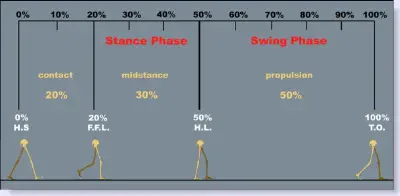
CONTACT PHASE The first phase of gait. This is where your heel as it goes forward hits the ground. Normal contact of the heel is on the posterior outside of the heel, not the direct back of the heel. So, normal heel wear will occur on the posterior outside of the heel. If your heels wear out directly on the back side of the heel or even the posterior inside of the heel, you do not have a normal gait.
This phase continues until the foot is flat on the ground. This constitutes 20 percent of the total gait cycle.
MIDSTANCE This part of your gait represents 30 percent of the cycle, your body weight passes over your foot as the body comes forward. At this position your foot (in this case the right foot) supports your body weight. This is the part of the gait pattern where an abnormally functioning foot such as an over pronated foot (flat foot) or an over supinated foot (high arch foot) will manifest its problems.
This phase ends as your body weight passes forward eventually forcing your heel to rise.
These two phases which represent one half of the total cycle is the part of the gait pattern where you will experience most heel, arch and midfoot pain.
PROPULSION PHASE This is the last phase of gait where the foot pushes off the ground to propel the body forward. Most forefoot pain results in this phase of the cycle. Fifty percent of the gait cycle is represented in this phase.
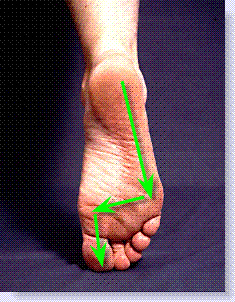
Below is a picture of weight distribution pattern seen in normal gait. The heel initially picks up the body weight, the weight then is distributed along the lateral or outside part of the foot. Body weight is then picked up by the ball of the foot and lastly the weight is absorbed by the big toe as you push off with that foot.
|
It is important to note that any abnormality in walking not only will have an abnormal effect on foot function but since the foot is the foundation of the human body, there can also be problems all the way up to the lower back. That is why correcting abnormalities at the level of the feet can go a long way in relieving pain occurring in the ankles, knees,legs,hips and lower back.
Want more information? CLICK HERE


Recent Articles


-
Vitamin D impact on health
Feb 06, 23 07:17 PM
Researchers are suggesting that the effectiveness of Vitamin D in fighting and preventing disease is predicated on a persons body mass index (BMI). The thinner the person the greater the positive impa… -
Foods to speed up healing
Feb 01, 23 02:41 PM
One of the best ways to help yourself heal faster after surgery is to eat well. Getting the proper nutrition will provide your body with the essentials it needs to promote healing. Here is a suggestio… -
Cancer and Type 2 Diabetes
Jan 25, 23 04:52 PM
An article revealing that older type 2 diabetics have a higher incidence of cancer then non-diabetics. It is suggested that cancer may surpass CVD as the number one cause of death in older diabetics. -
Does glucosamine or MSM reduce arthritis pain?
Jan 22, 23 01:41 PM
A good review of the possible benefits to taking glucosamine, chondroitin or MSM for arthritis. Always beware of the possible side effects of over the counter supplements. -
shin splints
Jan 18, 23 05:12 PM
A great review on the various causes of shin splints, along with treatment options. -
Whats new in skin cancer?
Jan 15, 23 08:32 PM
A presentation of newer skin protection combinations in an effort to better protect the skin from the hazards of sun exposure. -
Causes and risk factors of warts
Jan 14, 23 05:02 PM
A good review of the causes of warts and protective measures you can take to prevent developing them. -
Do chronic wounds need to be dressed daily?
Jan 11, 23 02:18 PM
Because of supply chain shortages as well as staffing shortages particularly during the pandemic, many institutions extended the time between dressing changes for chronic wounds. Is this really the be… -
Food choices that raise your risk of type 2 diabetes
Jan 08, 23 10:07 AM
A good review of how blood sugars can become elevated and the harm that can do. Certain food groups have a tendency to raise your blood sugars and should be avoided. -
Outcome stats from Scarf bunionectomy
Jan 03, 23 03:04 PM
The Journal of Foot and Ankle Surgery recently reported a meta analysis of outcomes in 1583 Scarf bunionectomies that met their inclusion criteria. Adverse events did not seem to be any better or wors…
