blisters
AUTHOR: Marc Mitnick DPM
home --> blisters
WHAT ARE BLISTERS
This condition is a very common cause of growths that cause pain in the foot. They occur frequently on the bottom of the feet but can also be seen on the top and side of the foot. By definition, they are an accumulation of fluid in the upper layer of skin, known as the epidermis.
These lesions can have clear fluid within them, or they may also contain blood or pus.
WHAT CAUSES BLISTERS
In the foot at least, the primary cause is friction. The most common cause is a poor fitting shoe combined with an activity that creates excessive friction on a certain part of the foot.
You can also develop blisters from skin conditions such as eczema, athletes foot, allergic reactions and bacterial infections.
In addition they can occur from burns, both heat and chemical burns.
Moist feet will increase friction.
From the excessive friction the upper layer of skin, the epidermis, separates from the middle layer of skin, the dermis. Fluid fills in and the blister is formed. Initially the lesion is formed to actually protect an area but more often than not, on the foot the growth will begin to hurt.
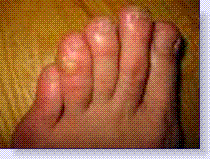
When these lesions are found on the tops of the toes they are usually the result of hammertoes where they create friction between the tops of the toes and shoes, usually dressier type shoes that do not allow enough room for the hammertoe deformity. Wearing a boxier shoe goes a long way in reducing these growths on the tops of the toes.
A typical scenario that plays out in my practice is an athlete such as a runner or tennis player that has been doing a lot of his sport in hot sticky weather. The excess friction of the sport combined with the wetness of the foot allows easy formation of the blisters. Generally the size and location of these growths will determine the amount of pain.
Another scenario is one where a person, usually a woman, wears a shoe that just does not properly fit the foot. This creates pressure points and many times these pressure points will end up blistering.
The last example is someone who presents to the office with an eczema or athletes foot eruption. These lesions generally do not hurt but are just part of the overall presentation of the affected skin.
Note the blisters on the toes in the picture below.
|
SYMPTOMS AND DIAGNOSIS
Some hurt, others do not, so symptoms can vary. I have had patients who first realized they had a blister simply because the bottom of their foot felt wet. Others will only realize they have one because they have noticed blood or pus on their sock. Others will realize they have this problem simply because they inspected their feet.
This is one of the easiest conditions to diagnose since almost everyone has had a blister somewhere on their body at one time or another. The reason for its occurrence can be a whole another issue. If the proper cause of the formation is not identified, the growth will continue to recur.
BLISTER TREATMENT
In a normal healthy individual who has good circulation and is not diabetic, pustule formation is a minor problem. The key to treating these lesions and those occurring anywhere else, that are going to be further subjected to friction, is to drain the growth without removing the top portion of it. This works primarily for the friction type. Blisters occurring for other reasons should be evaluated by a doctor.
The best way to do this:
- Clean a needle with alcohol.
- Pierce the blister in at least two places.
- Put pressure on the cap of the growth to squeeze out the fluid.
- Once drained it is important to not remove the cap as this acts as a protective barrier against the raw skin that is on the bottom of the lesion.
- put an antiseptic such as Neosporin or Bacitracin ointment on the wound and then cover it with a dressing under compression so that the fluid does not build up again.
- Apply antiseptic for a few days. The cap will dry out and the raw skin will harden. At that point you may cut away the dead dry skin and the underlying skin should be fine.
If during these few days you start to notice an increase in pain and the surrounding area appears to be getting more red in color, perhaps oozing a bit, there is a good chance the area is infected. At this point you should see a doctor for further treatment.
Generally blisters are a minor problem. However, this can change in certain circumstances. If you happen to be diabetic, have poor circulation, or suffer from any major debilitating disease you must be careful. In these instances the prudent move would be to see a foot specialist and let he or she take care of it.
Additionally, most friction blisters occur as one or possibly two lesions. If you find yourself developing multiple lesions for no explainable reason; if they itch and there is scaling in the area, more than likely you have a fungal infection or eczema. In these instances a visit to a foot specialist is warranted as it will require professional treatment.
PREVENTION
For those of you prone to forming friction blisters there are a few things you can do. The first is obvious; make sure your shoes are not too tight. Even if they seem to fit fine check the inside of the shoe for stitching that may aggravate certain parts of the foot.
Additionally, since moisture (perspiration) increases the likelihood of this problem, keeping your feet and socks dry will go a long way in reducing recurrence. Using drying agents on your feet such Drysol or Bromilotion (Gordon Labs) will help.
If this problem routinely forms on the bottom of the foot, sometimes adding an orthotic with a Spenco topcover will reduce the friction. For more information on blisters and orthotics, click here.
Other tricks for treating this condition include wearing two pair of thin cotton socks with a little powder between them. This too will reduce the friction on the bottom of the feet.
Lastly, sometimes toughening up the skin in certain prone areas will reduce recurrence. This can be accomplished by applying tincture of benzoin liquid (not the spray; too messy) to the area, let it dry for a minute or so. It will become “tacky”. Then take any dry skin lotion and rub it into the sticky area. Do this on a regular basis and the skin should become hard enough that it will stop blistering. Do not do this while you have an active blister; do this on healed skin.
REFERENCES
American Academy of Dermatology
Want more information? CLICK HERE


Recent Articles


-
Vitamin D impact on health
Feb 06, 23 07:17 PM
Researchers are suggesting that the effectiveness of Vitamin D in fighting and preventing disease is predicated on a persons body mass index (BMI). The thinner the person the greater the positive impa… -
Foods to speed up healing
Feb 01, 23 02:41 PM
One of the best ways to help yourself heal faster after surgery is to eat well. Getting the proper nutrition will provide your body with the essentials it needs to promote healing. Here is a suggestio… -
Cancer and Type 2 Diabetes
Jan 25, 23 04:52 PM
An article revealing that older type 2 diabetics have a higher incidence of cancer then non-diabetics. It is suggested that cancer may surpass CVD as the number one cause of death in older diabetics. -
Does glucosamine or MSM reduce arthritis pain?
Jan 22, 23 01:41 PM
A good review of the possible benefits to taking glucosamine, chondroitin or MSM for arthritis. Always beware of the possible side effects of over the counter supplements. -
shin splints
Jan 18, 23 05:12 PM
A great review on the various causes of shin splints, along with treatment options. -
Whats new in skin cancer?
Jan 15, 23 08:32 PM
A presentation of newer skin protection combinations in an effort to better protect the skin from the hazards of sun exposure. -
Causes and risk factors of warts
Jan 14, 23 05:02 PM
A good review of the causes of warts and protective measures you can take to prevent developing them. -
Do chronic wounds need to be dressed daily?
Jan 11, 23 02:18 PM
Because of supply chain shortages as well as staffing shortages particularly during the pandemic, many institutions extended the time between dressing changes for chronic wounds. Is this really the be… -
Food choices that raise your risk of type 2 diabetes
Jan 08, 23 10:07 AM
A good review of how blood sugars can become elevated and the harm that can do. Certain food groups have a tendency to raise your blood sugars and should be avoided. -
Outcome stats from Scarf bunionectomy
Jan 03, 23 03:04 PM
The Journal of Foot and Ankle Surgery recently reported a meta analysis of outcomes in 1583 Scarf bunionectomies that met their inclusion criteria. Adverse events did not seem to be any better or wors…