- Home
- cellulitis
• Cellulitis is a bacterial infection that enters through a break in the skin and causes redness, swelling, and tenderness that can rapidly worsen without proper medical treatment.
• In the foot, it commonly develops from heel fissures, ulcers, burns, trauma, athlete’s foot, surgical incisions, or even swollen or dry skin, and is especially dangerous in diabetics or anyone with a weakened immune system.
• Symptoms may include fever, chills, swollen lymph nodes, and in severe cases the infection can spread to the bloodstream or bone, leading to systemic illness or osteomyelitis.
• Mild cases may respond to cleansing, dressings, and topical antibiotics, but more extensive infections require oral antibiotics based on wound culture results, with MRSA and Pseudomonas requiring specific drug choices.
• Failure to complete antibiotics can cause recurrence, and improperly treated infections may progress to the point of needing bed rest, IV antibiotics, or hospitalization.
cellulitis
Author: Dr. Marc MitnickReviewed by: Medical Review Board
Cellulitis occurs when one or more types of bacteria enter through a crack or break in the skin and an infection ensues. The condition manifests itself as a "redness" and "swelling" which is the cardinal signs of an infection.
CAUSES OF CELLULITIS
In the foot, sources of breaks in the skin and resulting infections include:
- heel fissure
- ulcers
- burns
- insect bites
- trauma
- cuts
- scratches
- surgical incision-possibly the most common risk in all surgery is the chance of infection.
- athletes foot-a secondary bacterial infection is very common with athletes foot which is one of the reasons that even if you have a mild case of athletes foot it should be treated.
- dry flaky skin
- swollen skin
- thrombophlebitis-in this case cellulitis can develop with no actual break in the skin.
For reasons just stated, cellulitis therefore is very common in the foot and lower leg. This condition is caused by bacteria, generally streptococcus or staphylococcus, but there can be other bacteria mixed in. This is especially true in diabetics.
People whose immune systems are weakened for any reason (including from chemotherapy for cancer or other immune-suppressing drugs) and those with diabetes or AIDS are at highest risk for developing infections.
SYMPTOMS OF CELLULITIS
Presents locally:
- swelling
- redness
- tenderness
- fever
- chills
- elevated oral temperature
- swollen lymph nodes
In more severe cases untreated cellulitis can get into the blood stream leading to systemic manifestations such as kidney failure or heart failure. Locally, the soft tissue infection may invade adjacent bone resulting in osteomyelitis.
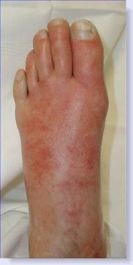
Below is a picture of cellulitis in the foot.
|
To further complicate matters, other problems will cause similar symptoms in the foot, these include:
- superficial phlebitis
- fracture
- tendonitis
- gout
- local trauma to the foot
TREATMENT OF CELLULITIS
SIMPLE INFECTIONS-Treatment is predicated on the severity of the condition. In a case of a healthy individual who has developed cellulitis secondary to an infected ingrown nail and it only extends an inch or so from the infection site, removal of the offending portion of nail and topical antibiotic medication is all that is usually necessary.
Small localized infections may be treated with simple cleansing with soap and water, along with a dressing which includes a topical antibiotic ointment.
SEVERE INFECTIONS-In the patient who may be diabetic, may be on immuno-suppressive drugs, a wound has to be evaluated for infection. General guidelines as to whether or not a wound requires oral antibiotics include the degree to which there is cellulitis (redness that extends way beyond the borders of the wound), an increase in pain in the area, poor quality of granulation tissue in the wound, increased drainage from the wound, tunneling (channels leading deeper into the tissue) and odor. If the patient has an elevated oral temperature, that too has to be considered.
cellulitis and antibiotics
If the criteria is met an oral antibiotic is prescribed. Your doctor will normally start you on an oral antibiotic that is known as a broad spectrum antibiotic; an antibiotic that kills a wide variety of bacteria. At the same time, your doctor will take a sample of drainage in the wound and send it out to a laboratory to find the specific organisms causing your infection. Most skin infections are either staph aureus (most common) or strep infections. In these instances a first generation cephalosporin or perhaps a penicillin type antibiotic will be prescribed.
Complicating the bacteria picture, in recent years are the methicillin resistant staph aureus bacteria (MRSA). They do not respond to the broad spectrum drugs just mentioned. A popular option for MRSA is doxycycline 100mg twice a day for upwards of ten days.
Pseudomonas infections are also fairly common in skin infections of the foot and lower leg. Generally the signs of infection will not be as severe as seen with staph and strep. The drug of choice here is the group of antibiotics known as quinolones. It is worth mentioning that quinolones have a tendency to cause tendon ruptures, primarily the Achilles tendon, so it is important to be aware of this, if you are presently taking this medication.
The key here is to take all of the antibiotics no matter how good the foot may look after a day or so. Typically, what happens is that the infection begins to look and feel much better in a couple of days and the patient will stop taking the antibiotics only to experience what is known as a rebound phenomenon where the redness and infection return, thus delaying the time it takes to ultimately clear up the problem.
When your doctor suspects an infection that requires an oral antibiotic, he or she will initially start you on one of the above mentioned drugs. In addition, your doctor has to find out exactly what organism(s) is causing your infection. This is done with what is known as a wound culture. In years gone by your doctor would swab the top of the wound with a Q-tip like swab and send that to the lab to find out which bacteria is involved. That thinking has changed.
The real organisms that are causing your infection generally lie deeper in the wound. The organisms that lie on top of the wound are known as normal colonized bacteria (they are just bacteria sitting in the wound). The proper way to culture a wound is to actually clean the surface of the wound with an antiseptic, then swab the wound as deep as the swab can be placed without torturing the patient.
The more recent thinking is to actually remove a small piece of deep tissue and send that out for testing as that is the "best" way to get an accurate reading. Once the results come back from the lab, your doctor may switch the antibiotic you are taking to a different one that is more specific for the bacteria found in the wound culture.
Locally, the affected area will also be treated with topical medication and a dressing to prevent re-infection. If there is an underlying cause such as athletes foot , fissuring , dryness in the skin or foot ulcers , they all have to be addressed otherwise the risk of re-infection remains high.
Unfortunately, simple infections that are improperly treated many times will turn into a severe infections. Depending on the overall health status of the patient, bed rest, intravenous antibiotics and possibly hospitalization may all be necessary.
Cellulitis is not a condition that can be self treated. It requires proper medical care.
See also....wound care
REFERENCES
American Academy of Dermatology
Frequently Asked Questions
What is cellulitis?
Cellulitis is a bacterial skin infection that causes redness, swelling, and tenderness after bacteria enter through a break in the skin. It is especially common in the foot and lower leg.
What causes cellulitis in the foot?
Any break in the skin can allow bacteria to enter. Common sources include heel fissures, ulcers, burns, cuts, trauma, athlete’s foot, surgical incisions, and even swollen or dry skin.
Who is at higher risk for cellulitis?
People with weakened immune systems are more likely to develop cellulitis. This includes individuals with diabetes, AIDS, cancer patients on chemotherapy, and those taking immune‑suppressing medications.
What are the symptoms of cellulitis?
Local symptoms include redness, swelling, and tenderness. Systemic symptoms may include fever, chills, swollen lymph nodes, and in severe cases the infection can spread to the bloodstream or bone.
How is cellulitis treated?
Treatment depends on severity and may include cleansing, dressings, topical antibiotics, or oral antibiotics based on wound culture results. Severe infections may require bed rest, IV antibiotics, or hospitalization.
Questions I Have Answered From Visitors
Visitor Name: Marcie Wolf
Location: Kansas, United States
Question: Toe Cellulitis
My daughter has had toe cellulitis (staph) since 2/10/09. Has been treated with 2 rounds of Keflex, 1 round of Augmentin, bactroban and tinactin ointment, soaked in clorox and epsom salt and washing with dial soap. It cleared up after the 1st round of Keflex but come back and has not cleared up since.
Toe is hot to touch, hard to move and very red. Please help!
RESPONSE
Hi Marcie,
More than likely the toe nail will have to be removed. What generally happens in these cases is that while on the antibiotics the infection is suppressed giving the appearance of improvement, once off the medication the infection returns in full force.
Key Observation: By removing the nail (and allowing it to grow back), the source of the infection can be cleaned out and with the help of antibiotics, the infection should clear up once and for all.
The last thing you want to do is to keep your daughter on a constant regimen of antibiotics.
Marc Mitnick DPM
If you happen to live in the New York - New Jersey area and would like to visit our office
|
|
To make an appointment online or for directions to our office click Dr. Marc Mitnick.
DISCLAIMER: The purpose of this site is purely informational in nature. It is not intended to diagnose, treat or cure any medical condition. This information is not a substitute for advice from a medical professional. Please consult your healthcare provider for accurate diagnosis and treatment. The information presented here may be subject to errors and omissions.
SITE LAST UPDATED: September 2026


I've been doing some aggressive research lately (it's how I found your incredible website) and realize now that my symptoms are not consistant with the diagnosis.
Jennifer
Hunterville, NC
….after reviewing your amazing site (great for the avg. jill). So thank you very much!!!
Liesbeth
NY
I am really, really impressed with your plain-speak explanations for the various conditions.
Jacqueline
NJ
This was an extremely helpful site. I have an appointment on the 18th and your info. Was right on target…..
Jack
Fla
A well organized site containing much information written in a manner that the average reader can comprehend.
Jean
Ontario, Canada
I found your website and articles most interesting.
Andrew
Fla.
Thank you for a quick response. I think your site is the best information site on foot pain and I have viewed many.
Judy
(location unknown)
I came to your website, footspecialist.net via www.foot-pain explained .com which I think is also your website? I thought explanations for different types of problems were well addressed and thoughtfully stated for the patient in mind.
L.W.
New York
You have an amazing and extremely informative site. I enjoyed looking through all of the data and stats.
Yvette
Memphis, TN
Thanks again so much for the information in the article. Very interesting.
Anna
Scotland
Great article. I have had plantar fasciitis since I was in high school……..
J. Simmons
(location unknown)
Dear Dr. Mitnick, The orthotics arrived four days ago and I slipped them into my shoes immediately. I was skeptical as to the usefulness of the item, they really didn't look very exotic. I have to say though, after using them for just four days, I have experienced grand relief from my foot pain. Even the very first day, I was able to do a lot of work while on my feet with at least a 75% reduction of pain. It has only gotten better every day, and I go nowhere without my shoes with the orthotics. I had been experiencing extreme heel and sole pain for about six months and had to take extended breaks off my feet many times a day as well as regular doses of Ibuprofen. Since getting the orthotics, my life has returned to normal and I feel good again. Just wanted to say thanks for the recommendation for a very effective item, I had no idea what a change this item could affect.
Yours truly,
J.C. Forbes
Tennessee
Thanks for the Response, you hit it on the head.
Steve
Redondo Beach, CA
Thank you for your time and expertise in answering my question…..
LH
(location unknown)
First, thanks for putting together this website. Its the most informative site I have found dealing with foot problems. Last June I started having pain and swelling at …….
Joe
(location unknown)
First of all, thank you for having all this useful information available in one place. I've been through most of your website and based on my research, pain and evaluations I think I've narrowed things down quite a bit.
Pete M.
(location unknown)
Thank you for the best site I have found when researching foot pain.
Glenda B.
Madison, Alabama
Thanks for replying so quickly. I was a bit concerned. I think your website is great, and chock full of info.....
Carol
Denison, TX
Dr. Marc, Thank you so much for your reply which seemed to be right on. I have researched many sites but you put me on the right path to the possible answer. My foot pain may not rule the rest of my life after all! I believe I'll make a sign that reads, "THE END IS NEAR!" Thanks Very Much,
Dawn
West lafayette, IN
Dear sir...no doubt you get positive comments re your site...May I please be added to the list of your admirers. In all of my years of web surfing I would say your site is right there with the very best. Thank you for taking the time to write the terrific info you provide and for putting things into laymen terms for us mere mortals. I pray you have much on going success and thank you again for a deed well done. As for me I did not find much help for my symptoms and will continue on my quest. Were you anywhere in the South I would make and appointment...Thanks again dear sir...m.e.
Michael E.
Tampa, Florida 33624
Hi. This is a great site! I'm a healthy middle aged woman who is in good health, but.....
Kelly
Texas
Just a wee word of thanks for your wonderful website...It is a terrific service...Thank you for providing your knowledge and help...With highest regards, m ebeling
Michael D. Ebeling
Tampa, Florida 33624
Thanks for a most interesting website, which has helped a lot.
Steve
UK
Dear Dr.Mitnick
I usually do my research on the Mayo clinic website. I think your website is the most informative site I have found when researching foot pain.
I thank you for putting together this incredible website.
Regards,
Dragica W.
Edmonton,Canada
....I have been told that it is not hard enough to be cut off. Please help, I am not sure what to do now! THANKS FOR A WONDERFUL AND VERY HELPFUL SITE!
Roxy
South Africa
You have an unusually clear, informative and well-written website for laypersons. Thank you for that.
Matthew W.
Mansfield Ctr, CT
First, I'd like to thank you for all the information that you provide on your website and the opportunity to write to you.
Steve
Placentia, California
First, I want to let you know that you have the best web site I've found related to foot issues. (The only thing I had difficulty finding was the "ask a question" page.)
Unknown
Unknown location
I received the orthotics Monday afternoon and began wearing them Tuesday. After two days I would say that I have noticed a huge improvement in the discomfort I have been experiencing. My foot feels better than it has in months.
Ric J.
Unknown location
I greatly admire someone like you who would donate and dedicate so much time and effort to helping strangers with no compensation. Truly, it is uncommonly kind. And your site is so intelligently arranged.
Ron R.
Pacific Grove, CA
I used to work for a podiatrist (front desk) back during summers in college years ago, so I know the benefits of good care. Again, I want to thank you for an EXCELLENT website. It was so great to get to your site (top of google search) and actually find all the answers I needed EASILY and QUICKLY! Clearly you put a ton of work into it and I really appreciate it.
All the best,
Victoria
Alameda, California
By the way, millions of websites could use yours as a guideline on how to organize information and make the site user-friendly. Kudos to you!
Anonymous
Thank you for your very interesting and informative site!
Anonymous
Hi. I come to your site often looking for information. It is really informative and I appreciate it very much. I have RA and have been having considerable amount of foot pain...... Dee RN
Thanks very much for the wonderful informative site.
Catherine
New Zealand
Thank You for my answer! I have been schedule for a bone density scan, allingment, and I am in the process of getting orthotics made, and checking out the natural remedies. Thank again! What a great web site!
Sincerely
Josette
Yes I want both pair of orthotics. You don't have an option of ordering 2 at one time so I had to place the order twice. Thanks. My husband likes these and wants to put them in all of his shoes. (referring to Superstep orthotics)
Cindy H.
Arizona
I searched the internet everywhere for a clear description and illustration of my symptoms/problem. https://www.foot-pain-explained.com/ was where I ended my search with answers. If I lived in Jersey (left 30 years ago) and didn't live in Florida I would definetly make an appointment with Dr. Mitnick.
Thanks, Kathy
Florida
1st of all THANKS A LOT for your great site......
Anna
Poland
Thank you so much for your response. I will let you know how I am doing if you would like. Your website is awesome!
M P
South Carolina
Hello! I want to thank you for such an informative website! I found you based on my ankle pain search and am happy to realize that there may be a relatively simple cause and solution....
Natalie
unknown location
...Thanks for your fantastic service.
Gary
Arlington, VA
Thank you so very much, that would be much appreciated. I love those insoles, by the way. (referring to Superstep orthotics)
Kelly W.
San Clemente, CA
Dr Marc is fantastic...He seems to know exactly what you are feeling with the problems you are having. I wish he was in my home town so I could go to him with my problems!!!!!!!!!!!!!
Pam
location unknown
Great insights! Thanks Doc, you're the best.
Glen
location unknown
I have been experiencing foot pain of various sorts and am working to figure out what it is. I found this site and can only say BRAVO!! What an excellent site! The time it must have taken to put all this together must've been a daunting task! I am sure it has helped so many people. Thank you so very much for doing this.
Bre
location unknown
Dr. Mitnick, Thank you so much for your reply. I did let my physician know and they took an x-ray - all is well! Also, thank you for providing this wonderful site, it is very helpful with lots of useful information! I appreciate your gift of time! God bless.
anonymous
Dr. Mitnick, Thank you, you were 100% correct. The pain finally brought me to the ER. I spent 8 days in the hospital. The Doppler you spoke of was able to show that there was no pulse in that foot. This was an arterial clot that split and traveled throughout my leg. My leg was almost amputated. I am in rough shape but have all my parts intact!! You certainly know what you are talking about. Thank you for taking the time to answer. Yours Truly!
anonymous
Staying at home after hallux surgery I spend quite a lot of time seaching info useful for avoiding problems which might come back. Today I found your site and I am .... delighted it happened. It's one of the best site I found last days.
Anna
Poland
Thanks for taking time to read and answer so many questions. It is truly a public service!
Esh
Seattle, WA
I just wanted to say that I am very greatful for this website!!
Bonnie
location unknown
Also, and importantly, just want to praise this web site. Thorough and thoughtfully presented, it certainly must be of considerable assistance to anyone with a foot problem. Terrific -- and very interesting.I trust the address comes up easily for those seeking information.
Bill
New Jersey
Thanks so much for answering my question. You've been more help to me than my own Dr. has been lately. Thanks again....I hope to be able to walk without pain someday.
Debbie
location unknown
Wow, that is exactly the information needed!!! thank you thank you thank you!!! I appreciate this help so very much from Marc Mitnick DPM. Excellent information and help to improve One's life.
Chrissy
location unknown
Thanks so much for this website Dr. Marc! It is so nice that you have this ask the doctor feature..I'm sure I'ts been helpful for alot of people. I will try what you suggested and see if it helps...thanks again!
Tracy
Evansville, IA
Dear Marc
I just want to say thank you for the quick response and the good info. I find it amazing and a super nice thing that you do here by answering medical questions at no charge.
Russ W.
location unknown
Your website is full of a lot of helpful information, and I am very impressed with the time in which you responded to my post. Thank you again for your time and consideration in your response.
-Sunny.
location unknown
Thank you very much for the information, I will consider it. Excellent web site.
Jackie
San Diego, CA
Dr. Mitnick, Just want to say thank you so very much for your quick response and very informative reply! After reading what you had to say, I called the doctor's office and was able to get in and see him the same day as my injury. Toe was x-rayed and luckily, it is not broken or fractured. Very badly bruised and will probably lose the toe nail. And although my toe and toe nail are still very black and blue and very sore, they ARE both starting to feel a little better. So again, thank you! I am so very happy that I came across your website. The service you provide is outstanding and immeasurable!
Rivi,
Albany, NY
Thank you so much for all of your advice. In searching the web for people dealing with this same issue i can tell you that you are a Knight In shining Armor! If I lived in Jersey I would gladly be your Spokesperson. Hopefully next time you hear from me it will be good news. God Bless,
Jill S.
location unknown
THANK YOU SO VERY MUCH FOR YOUR TIME AND EFFORTS, YOU ARE SO VERY APPRECIATED. THANK YOU FOR ALL YOU DO.
Jackie
Whichita, KS
thanks again, this site is very helpful.
mark
Boston, MA
Like others have stated...This site is amazing and I am so thankful that it was created.
....Keep up what your doing. Your a life saver.
Michelle
Colorado
Thanks again for the information provided on your site. It's easy for non-medical folk to understand your writing, and helps provide better communication between patient and doctor.
annielou
Colorado
Wonderful advice
by: Anonymous
This is the best site for foot problem info.
Thank you for this information. This description fits my pain and inflammation behind my 2nd toe perfectly.
by: Max
location unknown
Again, I really appreciate that you responded to my inquiry, and that your mention of Parkinson's helped me to find my way to a diagnosis of this difficult to diagnose disease. Most patients see on average 16 doctors before they are diagnosed. I hope that you can help other people that ask for your expertise in the future.
Barb D.
Canada
I just wanted to say that I am very greatful for this website!! I have had a fusion in my rt foot and am finally getting a little bit better......
Bonnie
location unknown
Again, Thank you from the bottom of my heart for taking the time to answer my question....your an angel!
Nancie
Wisconsin
Thank you for your response. You have provided some great insight (to my question)....
Julie
location unknown
Thank-you so very much for responding so quickly and in such detail to my question!! I will give my surgeon a call today!! This website is terrific!!!! Thank-you again!
Renae
North Carolina
Many Thanks Dr Marc!
Thank you for your response. It sounds like a good plan to me. He did not cut the wart out first ...
KG
location unknown
Thanks again doc for having this website and we STILL need qualified Podiatrists in beautiful sunny Tampa Bay (Bradenton) Florida.
Bessie Mae
Florida
Dear Dr. Mitnick, Thank you so very much for taking your time to answer my question. You have greatly relieved my anxiety related to the continual tingly I feel in my feet. I will share your response with my podiatrist next week. God bless you for having this question and answer page on your website! Most gratefully,
Lynne T.
location unknown
Your webpage is excellent, I commend you on sharing your knowledge to the public.
Robert
New Jersey
Thank you. you were more detailed than what others have told me they finally called from the last xrays and my son is now in a cast for 2 weeks he did have a fracture that was not noticeable.
a mom
location unknown
I have read your website and I have to admit that I am amazed at all the information that is on here. I have learned more than the three years I have been going to several doctors that I have seen!!
Melody
Lenoir, NC
Thank you so much Doc for a quick and thorough response!
Rustam
Bellevue, WA
I cannot thank you enough for your response, opinion, and suggestions! I want you to know how much it means to me, and I'm sure everyone else who has ever asked you a question! I feel like you're a lifesaver and have empowered me to take a stronger role and stand up for myself and my feet!
Jodi
location unknown
Recent Articles


-
Vitamin D impact on health
Feb 06, 23 07:17 PM
Researchers are suggesting that the effectiveness of Vitamin D in fighting and preventing disease is predicated on a persons body mass index (BMI). The thinner the person the greater the positive impa… -
Foods to speed up healing
Feb 01, 23 02:41 PM
One of the best ways to help yourself heal faster after surgery is to eat well. Getting the proper nutrition will provide your body with the essentials it needs to promote healing. Here is a suggestio… -
Cancer and Type 2 Diabetes
Jan 25, 23 04:52 PM
An article revealing that older type 2 diabetics have a higher incidence of cancer then non-diabetics. It is suggested that cancer may surpass CVD as the number one cause of death in older diabetics. -
Does glucosamine or MSM reduce arthritis pain?
Jan 22, 23 01:41 PM
A good review of the possible benefits to taking glucosamine, chondroitin or MSM for arthritis. Always beware of the possible side effects of over the counter supplements. -
shin splints
Jan 18, 23 05:12 PM
A great review on the various causes of shin splints, along with treatment options. -
Whats new in skin cancer?
Jan 15, 23 08:32 PM
A presentation of newer skin protection combinations in an effort to better protect the skin from the hazards of sun exposure. -
Causes and risk factors of warts
Jan 14, 23 05:02 PM
A good review of the causes of warts and protective measures you can take to prevent developing them. -
Do chronic wounds need to be dressed daily?
Jan 11, 23 02:18 PM
Because of supply chain shortages as well as staffing shortages particularly during the pandemic, many institutions extended the time between dressing changes for chronic wounds. Is this really the be… -
Food choices that raise your risk of type 2 diabetes
Jan 08, 23 10:07 AM
A good review of how blood sugars can become elevated and the harm that can do. Certain food groups have a tendency to raise your blood sugars and should be avoided. -
Outcome stats from Scarf bunionectomy
Jan 03, 23 03:04 PM
The Journal of Foot and Ankle Surgery recently reported a meta analysis of outcomes in 1583 Scarf bunionectomies that met their inclusion criteria. Adverse events did not seem to be any better or wors…