- Home
- orthotics
orthotics
Custom orthotics are prescription-made medical devices designed to correct abnormal foot function and reduce stress throughout the feet, ankles, legs, and even the lower back. Unlike store‑bought arch supports, they are crafted specifically for an individual’s foot structure, biomechanics, and medical condition.
These devices can be accommodative—built to cushion and protect painful or arthritic feet—or functional, designed to improve the way the foot moves during the gait cycle. By correcting excessive pronation or insufficient pronation (supination), orthotics can relieve pain, improve alignment, and reduce strain on joints and soft tissues.
To create custom orthotics, a plaster cast or other precise impression of the feet is taken in their neutral position and sent to a specialized lab. Materials and modifications vary depending on the patient’s needs, such as shock‑absorbing materials for rigid, high‑arched feet or targeted cutouts for conditions like sesamoiditis or neuromas.
Custom orthotics are used for a wide range of conditions including heel pain, plantar fasciitis, shin splints, ankle instability, arthritis, diabetic foot protection, running injuries, pediatric gait abnormalities, and forefoot pain. While over‑the‑counter inserts may help mild, vague symptoms, they cannot match the precision, durability, or corrective capability of prescription devices.
Reviewed by: Medical Review Board
WHAT ARE CUSTOM ORTHOTICS
It is a custom made device fitted directly to a patient’s feet. It requires a doctor's prescription. Unlike an arch support that anyone can buy in a store, a prescription orthotic is a device that is built for a specific individual and in most cases a specific foot or leg problem.
So if you and your uncle Bill have the same shoe size, his prescription inserts will not fit you, just like your prescription eyeglasses will not fit him.
A prescription insert is used to treat all sorts of foot, leg and even lower back problems. (Orthotics should not be confused with an ankle foot orthosis which is a more complex device used to control the foot, ankle and lower leg generally reserved for more severe musculo-skeletal and neurological problems.)
An abnormally functioning foot can have an adverse affect all the way up to the lower back. Over the years I have put patients in prescription devices for a foot problem only to have them come back and report that their back pain has improved as well.
As just stated prescription orthotics are used to treat abnormally functioning feet, for the purpose of this discussion basically either feet that over flatten when a patient walks (pronation) or feet that do not flatten out at all (supination). Both types of abnormal functioning feet create problems from the feet to the back, however, pronation problems are seen more frequently than supination problems.
To better understand the gait cycle and how orthotics may help, click here.
Prescription orthotics are further divided into two types. One is an accommodative orthotic. This device as the name implies accommodates a problem. For example, if you suffer from very arthritic feet an accommodative orthotic may be built that would better support your feet in an effort to reduce the stress being placed on the arthritic joints and not force the joints to have to go through their full range of motion which is what usually causes pain, since the primary sign of arthritis is the limitation of motion in the affected joint.
The other type of prescription orthotic is known as a functional orthotic. This is a type of orthotic that is built in an effort to change the way the foot functions in the gait cycle, to make up for the deficiencies in an individual's anatomical make-up. This type of orthotic attempts to change the biomechanics of the foot, which in turn may have a positive impact in the skeletal system all the way up to the lower back.
In order to make a prescription orthotic a plaster of paris cast is taken of both feet in their neutral position, the ideal relationship of the feet to the legs. Although there are other methods to take an “impression”, plaster casting is considered the most accurate (also the most messy) way of capturing the feet. These casts are sent to a professional lab where an orthotic is fabricated based on the recommendations of the prescribing doctor.
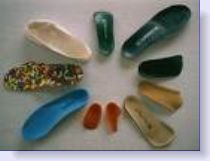
Prescription orthotics can be made out of a multitude of materials and may have various additions added to them based on the patient’s problem. For example, a patient with a supinated foot, generally exhibits poor shock absorption as his foot hits the ground. This inability of the foot to absorb shock allows the “shock wave” to travel up the leg where is can manifest itself as pain all the way to the lower back. In this case the prescription orthotic may be built out of materials that help absorb shock.
Notice the various types of orthotics that can be prescribed
|
Listed below are some of the conditions that a prescription orthotic may be used for:
- Heel spurs, plantar fasciitis
- Shin splints
- Ankle instability
- Arthritic conditions of the foot and ankle
- Sesamoiditis
- Diabetic foot protection and partial foot amputations
- Running injuries including runner’s knee
- Forefoot pain such as capsulitis, neuroma, metatarsalgia
- Treatment for mild bunions and hammertoes
- Pediatric problems such as in toeing and out toeing
- Juvenile bunions
- Apophysitis in children
- Adult biomechanical abnormalities
As you can see, there are many uses for an orthotic. Many times the question patients will raise is why can’t they buy an over the counter arch support.
In my office I never say never. BUT, for simple foot problems like a mild ache in the heel something over the counter may do the job. In fact many times patients will come to me having already tried something they bought in the drug store.
There are a number of issues here. First, store bought supports are sold by shoe size, not foot structure. So if you are a size ten shoe and buy a size ten arch support you have to hope that your arch support happens to be the same as your foot structure. There are any number of foot structures in the human anatomy, but you may be the lucky individual whose foot structure matches the arch support. In addition store bought arch supports do not address the weight of the patient. It would stand to reason that a person weighing 250 pounds would have different support needs than someone who weighs 150 pounds.
Although I cannot state that I have seen every arch support sold in drug stores and supermarkets, I can say that I have never seen one that is much better than the arch supports that come in a good pair of sneakers. So an easy rule of thumb might be that if you are having pain in spite of wearing reasonably good sneakers with a built in arch then purchasing a store bought arch support is probably a waste of your time and money.
Next, you have to hope that the arch support is built out of the material best suited to help your foot problem. Many prescription orthotics have padding added and cutouts made in certain parts of the orthotic to accomodate various foot problems. Your problem is that store bought arch supports do not come with any additions for specific foot problems like the prescription orthotics do.
running orthotics
For those of you who suffer from foot, ankle or leg issues associated with running, a different type of orthotic is often necessary. Not only does a sporthotic have to control your particular medical issue, but it has to be designed to withstand the stresses placed upon it by athletic activities. The takeaway here is that a regular orthotic designed for every day shoes, should not be used for sports. This includes both custom and store bought supports.
Next, is the life expectancy of the arch support vs. a prescription orthotic. Although a prescription orthotic is not designed to last forever (even though I have patients still wearing 30 year old orthotics), store bought arch supports generally last anywhere from 3-6 months depending on the patients activity.
Lastly, if you get lucky and your store bought orthotic happens to fit your foot contour and is supportive enough for your weight (not great odds of both those things happening), you have found yourself a partially accommodative orthotic. Yes, it might work for some of the problems an accommodative orthotic is designed for, but what if your problem really requires a functional orthotic? The odds of your store bought orthotic fulfilling that requirement is almost nil.
Does that mean I never recommend store bought arch supports? No, of course not. There will be situations where I suggest a patient try something from a drug store; I usually recommend a store bought arch support if the patient presents with vague symptoms of a potential problem, not quite severe enough to warrant aggressive treatment, but certainly something that should not be ignored. Since most people cannot wear sneakers all day, this is the next best option.
shoes for orthotics
Another consideration for orthotics is the types of shoes you intend to wear them in. Generally speaking men's shoes are not an issue as the cut of a dress shoe is not much different than an athletic shoe. The real problem occurs with women's shoes. Obviously an orthotic designed for a sneaker rarely will fit into a pump or high heel.
The problem is exacerbated by the fact that to get an orthotic into a very dressy shoe it has to be dramatically modified (translated: made much thinner and narrow) and of course this takes away from the effectiveness of the orthotic. It stands to reason that if a women is suffering from a severe foot problem and an orthotic is the answer, it will usually have to be a full functional orthotic which will generally require wearing conservative shoes.
Not sure if prescription orthotics are for you? Click here for the results of a recent study on prescription orthotics.
There are orthotics that are made for women's dress shoes but in most instances I find them to be a waste of time. For the reason stated above, the dress shoe orthotic has to be so modified in order to fit into the dress shoe that its effectiveness is usually minimal to none.
OK, so you finally got your prescription orthotics now what? I generally explain to people that orthotics are like eyeglasses. When you wear them they do what they were intended to do. At the end of the day, if you walk around the house barefoot, all the benefit derived from the orthotic is lost. Wearing orthotics all the time is mandatory, at least initially in treating painful conditions.
REFERENCES
Frequently Asked Questions
If you happen to live in the New York - New Jersey area and would like to visit our office
|
|
To make an appointment online or for directions to our office click Dr. Marc Mitnick.
DISCLAIMER: The purpose of this site is purely informational in nature. It is not intended to diagnose, treat or cure any medical condition. This information is not a substitute for advice from a medical professional. Please consult your healthcare provider for accurate diagnosis and treatment. The information presented here may be subject to errors and omissions.
SITE LAST UPDATED: September 2026

I've been doing some aggressive research lately (it's how I found your incredible website) and realize now that my symptoms are not consistant with the diagnosis.
Jennifer
Hunterville, NC
….after reviewing your amazing site (great for the avg. jill). So thank you very much!!!
Liesbeth
NY
I am really, really impressed with your plain-speak explanations for the various conditions.
Jacqueline
NJ
This was an extremely helpful site. I have an appointment on the 18th and your info. Was right on target…..
Jack
Fla
A well organized site containing much information written in a manner that the average reader can comprehend.
Jean
Ontario, Canada
I found your website and articles most interesting.
Andrew
Fla.
Thank you for a quick response. I think your site is the best information site on foot pain and I have viewed many.
Judy
(location unknown)
I came to your website, footspecialist.net via www.foot-pain explained .com which I think is also your website? I thought explanations for different types of problems were well addressed and thoughtfully stated for the patient in mind.
L.W.
New York
You have an amazing and extremely informative site. I enjoyed looking through all of the data and stats.
Yvette
Memphis, TN
Thanks again so much for the information in the article. Very interesting.
Anna
Scotland
Great article. I have had plantar fasciitis since I was in high school……..
J. Simmons
(location unknown)
Dear Dr. Mitnick, The orthotics arrived four days ago and I slipped them into my shoes immediately. I was skeptical as to the usefulness of the item, they really didn't look very exotic. I have to say though, after using them for just four days, I have experienced grand relief from my foot pain. Even the very first day, I was able to do a lot of work while on my feet with at least a 75% reduction of pain. It has only gotten better every day, and I go nowhere without my shoes with the orthotics. I had been experiencing extreme heel and sole pain for about six months and had to take extended breaks off my feet many times a day as well as regular doses of Ibuprofen. Since getting the orthotics, my life has returned to normal and I feel good again. Just wanted to say thanks for the recommendation for a very effective item, I had no idea what a change this item could affect.
Yours truly,
J.C. Forbes
Tennessee
Thanks for the Response, you hit it on the head.
Steve
Redondo Beach, CA
Thank you for your time and expertise in answering my question…..
LH
(location unknown)
First, thanks for putting together this website. Its the most informative site I have found dealing with foot problems. Last June I started having pain and swelling at …….
Joe
(location unknown)
First of all, thank you for having all this useful information available in one place. I've been through most of your website and based on my research, pain and evaluations I think I've narrowed things down quite a bit.
Pete M.
(location unknown)
Thank you for the best site I have found when researching foot pain.
Glenda B.
Madison, Alabama
Thanks for replying so quickly. I was a bit concerned. I think your website is great, and chock full of info.....
Carol
Denison, TX
Dr. Marc, Thank you so much for your reply which seemed to be right on. I have researched many sites but you put me on the right path to the possible answer. My foot pain may not rule the rest of my life after all! I believe I'll make a sign that reads, "THE END IS NEAR!" Thanks Very Much,
Dawn
West lafayette, IN
Dear sir...no doubt you get positive comments re your site...May I please be added to the list of your admirers. In all of my years of web surfing I would say your site is right there with the very best. Thank you for taking the time to write the terrific info you provide and for putting things into laymen terms for us mere mortals. I pray you have much on going success and thank you again for a deed well done. As for me I did not find much help for my symptoms and will continue on my quest. Were you anywhere in the South I would make and appointment...Thanks again dear sir...m.e.
Michael E.
Tampa, Florida 33624
Hi. This is a great site! I'm a healthy middle aged woman who is in good health, but.....
Kelly
Texas
Just a wee word of thanks for your wonderful website...It is a terrific service...Thank you for providing your knowledge and help...With highest regards, m ebeling
Michael D. Ebeling
Tampa, Florida 33624
Thanks for a most interesting website, which has helped a lot.
Steve
UK
Dear Dr.Mitnick
I usually do my research on the Mayo clinic website. I think your website is the most informative site I have found when researching foot pain.
I thank you for putting together this incredible website.
Regards,
Dragica W.
Edmonton,Canada
....I have been told that it is not hard enough to be cut off. Please help, I am not sure what to do now! THANKS FOR A WONDERFUL AND VERY HELPFUL SITE!
Roxy
South Africa
You have an unusually clear, informative and well-written website for laypersons. Thank you for that.
Matthew W.
Mansfield Ctr, CT
First, I'd like to thank you for all the information that you provide on your website and the opportunity to write to you.
Steve
Placentia, California
First, I want to let you know that you have the best web site I've found related to foot issues. (The only thing I had difficulty finding was the "ask a question" page.)
Unknown
Unknown location
I received the orthotics Monday afternoon and began wearing them Tuesday. After two days I would say that I have noticed a huge improvement in the discomfort I have been experiencing. My foot feels better than it has in months.
Ric J.
Unknown location
I greatly admire someone like you who would donate and dedicate so much time and effort to helping strangers with no compensation. Truly, it is uncommonly kind. And your site is so intelligently arranged.
Ron R.
Pacific Grove, CA
I used to work for a podiatrist (front desk) back during summers in college years ago, so I know the benefits of good care. Again, I want to thank you for an EXCELLENT website. It was so great to get to your site (top of google search) and actually find all the answers I needed EASILY and QUICKLY! Clearly you put a ton of work into it and I really appreciate it.
All the best,
Victoria
Alameda, California
By the way, millions of websites could use yours as a guideline on how to organize information and make the site user-friendly. Kudos to you!
Anonymous
Thank you for your very interesting and informative site!
Anonymous
Hi. I come to your site often looking for information. It is really informative and I appreciate it very much. I have RA and have been having considerable amount of foot pain...... Dee RN
Thanks very much for the wonderful informative site.
Catherine
New Zealand
Thank You for my answer! I have been schedule for a bone density scan, allingment, and I am in the process of getting orthotics made, and checking out the natural remedies. Thank again! What a great web site!
Sincerely
Josette
Yes I want both pair of orthotics. You don't have an option of ordering 2 at one time so I had to place the order twice. Thanks. My husband likes these and wants to put them in all of his shoes. (referring to Superstep orthotics)
Cindy H.
Arizona
I searched the internet everywhere for a clear description and illustration of my symptoms/problem. https://www.foot-pain-explained.com/ was where I ended my search with answers. If I lived in Jersey (left 30 years ago) and didn't live in Florida I would definetly make an appointment with Dr. Mitnick.
Thanks, Kathy
Florida
1st of all THANKS A LOT for your great site......
Anna
Poland
Thank you so much for your response. I will let you know how I am doing if you would like. Your website is awesome!
M P
South Carolina
Hello! I want to thank you for such an informative website! I found you based on my ankle pain search and am happy to realize that there may be a relatively simple cause and solution....
Natalie
unknown location
...Thanks for your fantastic service.
Gary
Arlington, VA
Thank you so very much, that would be much appreciated. I love those insoles, by the way. (referring to Superstep orthotics)
Kelly W.
San Clemente, CA
Dr Marc is fantastic...He seems to know exactly what you are feeling with the problems you are having. I wish he was in my home town so I could go to him with my problems!!!!!!!!!!!!!
Pam
location unknown
Great insights! Thanks Doc, you're the best.
Glen
location unknown
I have been experiencing foot pain of various sorts and am working to figure out what it is. I found this site and can only say BRAVO!! What an excellent site! The time it must have taken to put all this together must've been a daunting task! I am sure it has helped so many people. Thank you so very much for doing this.
Bre
location unknown
Dr. Mitnick, Thank you so much for your reply. I did let my physician know and they took an x-ray - all is well! Also, thank you for providing this wonderful site, it is very helpful with lots of useful information! I appreciate your gift of time! God bless.
anonymous
Dr. Mitnick, Thank you, you were 100% correct. The pain finally brought me to the ER. I spent 8 days in the hospital. The Doppler you spoke of was able to show that there was no pulse in that foot. This was an arterial clot that split and traveled throughout my leg. My leg was almost amputated. I am in rough shape but have all my parts intact!! You certainly know what you are talking about. Thank you for taking the time to answer. Yours Truly!
anonymous
Staying at home after hallux surgery I spend quite a lot of time seaching info useful for avoiding problems which might come back. Today I found your site and I am .... delighted it happened. It's one of the best site I found last days.
Anna
Poland
Thanks for taking time to read and answer so many questions. It is truly a public service!
Esh
Seattle, WA
I just wanted to say that I am very greatful for this website!!
Bonnie
location unknown
Also, and importantly, just want to praise this web site. Thorough and thoughtfully presented, it certainly must be of considerable assistance to anyone with a foot problem. Terrific -- and very interesting.I trust the address comes up easily for those seeking information.
Bill
New Jersey
Thanks so much for answering my question. You've been more help to me than my own Dr. has been lately. Thanks again....I hope to be able to walk without pain someday.
Debbie
location unknown
Wow, that is exactly the information needed!!! thank you thank you thank you!!! I appreciate this help so very much from Marc Mitnick DPM. Excellent information and help to improve One's life.
Chrissy
location unknown
Thanks so much for this website Dr. Marc! It is so nice that you have this ask the doctor feature..I'm sure I'ts been helpful for alot of people. I will try what you suggested and see if it helps...thanks again!
Tracy
Evansville, IA
Dear Marc
I just want to say thank you for the quick response and the good info. I find it amazing and a super nice thing that you do here by answering medical questions at no charge.
Russ W.
location unknown
Your website is full of a lot of helpful information, and I am very impressed with the time in which you responded to my post. Thank you again for your time and consideration in your response.
-Sunny.
location unknown
Thank you very much for the information, I will consider it. Excellent web site.
Jackie
San Diego, CA
Dr. Mitnick, Just want to say thank you so very much for your quick response and very informative reply! After reading what you had to say, I called the doctor's office and was able to get in and see him the same day as my injury. Toe was x-rayed and luckily, it is not broken or fractured. Very badly bruised and will probably lose the toe nail. And although my toe and toe nail are still very black and blue and very sore, they ARE both starting to feel a little better. So again, thank you! I am so very happy that I came across your website. The service you provide is outstanding and immeasurable!
Rivi,
Albany, NY
Thank you so much for all of your advice. In searching the web for people dealing with this same issue i can tell you that you are a Knight In shining Armor! If I lived in Jersey I would gladly be your Spokesperson. Hopefully next time you hear from me it will be good news. God Bless,
Jill S.
location unknown
THANK YOU SO VERY MUCH FOR YOUR TIME AND EFFORTS, YOU ARE SO VERY APPRECIATED. THANK YOU FOR ALL YOU DO.
Jackie
Whichita, KS
thanks again, this site is very helpful.
mark
Boston, MA
Like others have stated...This site is amazing and I am so thankful that it was created.
....Keep up what your doing. Your a life saver.
Michelle
Colorado
Thanks again for the information provided on your site. It's easy for non-medical folk to understand your writing, and helps provide better communication between patient and doctor.
annielou
Colorado
Wonderful advice
by: Anonymous
This is the best site for foot problem info.
Thank you for this information. This description fits my pain and inflammation behind my 2nd toe perfectly.
by: Max
location unknown
Again, I really appreciate that you responded to my inquiry, and that your mention of Parkinson's helped me to find my way to a diagnosis of this difficult to diagnose disease. Most patients see on average 16 doctors before they are diagnosed. I hope that you can help other people that ask for your expertise in the future.
Barb D.
Canada
I just wanted to say that I am very greatful for this website!! I have had a fusion in my rt foot and am finally getting a little bit better......
Bonnie
location unknown
Again, Thank you from the bottom of my heart for taking the time to answer my question....your an angel!
Nancie
Wisconsin
Thank you for your response. You have provided some great insight (to my question)....
Julie
location unknown
Thank-you so very much for responding so quickly and in such detail to my question!! I will give my surgeon a call today!! This website is terrific!!!! Thank-you again!
Renae
North Carolina
Many Thanks Dr Marc!
Thank you for your response. It sounds like a good plan to me. He did not cut the wart out first ...
KG
location unknown
Thanks again doc for having this website and we STILL need qualified Podiatrists in beautiful sunny Tampa Bay (Bradenton) Florida.
Bessie Mae
Florida
Dear Dr. Mitnick, Thank you so very much for taking your time to answer my question. You have greatly relieved my anxiety related to the continual tingly I feel in my feet. I will share your response with my podiatrist next week. God bless you for having this question and answer page on your website! Most gratefully,
Lynne T.
location unknown
Your webpage is excellent, I commend you on sharing your knowledge to the public.
Robert
New Jersey
Thank you. you were more detailed than what others have told me they finally called from the last xrays and my son is now in a cast for 2 weeks he did have a fracture that was not noticeable.
a mom
location unknown
I have read your website and I have to admit that I am amazed at all the information that is on here. I have learned more than the three years I have been going to several doctors that I have seen!!
Melody
Lenoir, NC
Thank you so much Doc for a quick and thorough response!
Rustam
Bellevue, WA
I cannot thank you enough for your response, opinion, and suggestions! I want you to know how much it means to me, and I'm sure everyone else who has ever asked you a question! I feel like you're a lifesaver and have empowered me to take a stronger role and stand up for myself and my feet!
Jodi
location unknown
Recent Articles


-
Vitamin D impact on health
Feb 06, 23 07:17 PM
Researchers are suggesting that the effectiveness of Vitamin D in fighting and preventing disease is predicated on a persons body mass index (BMI). The thinner the person the greater the positive impa… -
Foods to speed up healing
Feb 01, 23 02:41 PM
One of the best ways to help yourself heal faster after surgery is to eat well. Getting the proper nutrition will provide your body with the essentials it needs to promote healing. Here is a suggestio… -
Cancer and Type 2 Diabetes
Jan 25, 23 04:52 PM
An article revealing that older type 2 diabetics have a higher incidence of cancer then non-diabetics. It is suggested that cancer may surpass CVD as the number one cause of death in older diabetics. -
Does glucosamine or MSM reduce arthritis pain?
Jan 22, 23 01:41 PM
A good review of the possible benefits to taking glucosamine, chondroitin or MSM for arthritis. Always beware of the possible side effects of over the counter supplements. -
shin splints
Jan 18, 23 05:12 PM
A great review on the various causes of shin splints, along with treatment options. -
Whats new in skin cancer?
Jan 15, 23 08:32 PM
A presentation of newer skin protection combinations in an effort to better protect the skin from the hazards of sun exposure. -
Causes and risk factors of warts
Jan 14, 23 05:02 PM
A good review of the causes of warts and protective measures you can take to prevent developing them. -
Do chronic wounds need to be dressed daily?
Jan 11, 23 02:18 PM
Because of supply chain shortages as well as staffing shortages particularly during the pandemic, many institutions extended the time between dressing changes for chronic wounds. Is this really the be… -
Food choices that raise your risk of type 2 diabetes
Jan 08, 23 10:07 AM
A good review of how blood sugars can become elevated and the harm that can do. Certain food groups have a tendency to raise your blood sugars and should be avoided. -
Outcome stats from Scarf bunionectomy
Jan 03, 23 03:04 PM
The Journal of Foot and Ankle Surgery recently reported a meta analysis of outcomes in 1583 Scarf bunionectomies that met their inclusion criteria. Adverse events did not seem to be any better or wors…