- Home
- melanoma
melanoma
• Melanoma is a malignant transformation of a mole and is the most dangerous form of skin cancer. Although often associated with sun‑exposed areas, melanomas can appear on the feet—including the sole, between the toes, and beneath the toenails—where they may be overlooked or mistaken for benign conditions.
• Normal moles are typically uniform in color, have smooth borders, and are small in diameter. Concerning changes include asymmetry, irregular borders, multiple or unusual colors, and enlargement. These features—known as the A‑B‑C‑D criteria—help identify suspicious lesions that may require medical evaluation.
• Two high‑risk locations on the foot include the bottom of the foot and the spaces between the toes, where friction may promote malignant changes, and beneath the toenail, where dark discoloration that does not grow out with the nail can indicate a melanoma rather than trauma or fungus.
• A rare variant, amelanotic melanoma, lacks pigment and may appear pink, red, or flesh‑colored. Because it does not look like a typical dark mole, it is often diagnosed late and may be mistaken for eczema, granulation tissue, or an infected ingrown nail. Persistent lesions, especially those that bleed or fail to heal, should be examined promptly.
• Regular self‑exams and yearly dermatology evaluations are essential. Any mole that changes, looks unusual, or appears in a high‑risk location on the foot should be evaluated by a dermatologist or podiatrist. A biopsy is the only definitive way to diagnose melanoma.
Reviewed by: Medical Review Board
WHAT IS A MELANOMA
This is a mole that has undergone malignant changes. A malignant melanoma is the most deadly of all skin cancers. A mole is medically known as nevi. Normal moles are usually uniform in color being brown, black or tan. They will have even borders and usually no larger than the diameter of a pencil’s eraser. Moles may change in appearance over time, some are known to even disappear.
Some moles may become larger over time, may develop a mixture of color or may develop uneven borders. These moles are known as dysplastic nevi and are more prone to becoming malignant.
People at high risk for developing melanoma are those who have:
- A family history of or have had a melanoma in the past.
- Unusual moles on the skin, or changing moles.
- Fair skin, light hair and eye color, who sunburn easily or tan with difficulty.
- A history of painful or blistering sunburns as children or teenagers.
Since skin cancers are known to develop more commonly in the area of “BANS”, back, arms, neck and scalp which are the areas most exposed to the sun you might be wondering why I am discussing this condition since this web site is devoted to foot problems and the feet are generally not exposed as much to the sun as other parts of the body.
It is precisely for that reason that I am discussing this condition; to make my readers aware that they can occur on the feet and the feet themselves have certain characteristics that may promote the development of this malignancy.
The incidence of melanoma is equal between men and women, but in the lower extremity it is more common in females than males. The majority of cases present between 30-60 years of age.
melanoma facts
There are four different categories of this malignant mole, some of which are more virulent than others. It is not the purpose of this discussion to make you an expert on this condition, but rather make you aware of changes in moles that need to be examined by experts.
TWO UNIQUE LOCATIONS OF MELANOMA IN THE FOOT
Bottom of the foot or in between the toes
The reason we worry about moles in these locations is because of the friction that occurs on the skin in these areas, any moles that develop are more prone to undergoing malignant changes due to that excessive friction. So, just because a mole grows in between your toes and you figure it could not have possibly been affected by sun light is no reason not to keep an eye on it or have it inspected by a doctor.
|
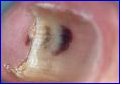
Melanoma under nail
Any dark discoloration underneath the nail whose origin cannot be explained needs to be examined. In the vast majority of the cases the discoloration that may occur under the nail is either from trauma to the nail and the subsequent bleeding that occurs or from a fungus growth that may develop. See my discussion on nail fungus.In both those cases, the discoloration should grow forward as the nail grows and eventually will be cut away at the end of the nail. If there is a dark discoloration under the nail that does not seem to be growing forward, (it just stays in the same place) than that discoloration should be considered suspicious. In my office in most cases I can cut away enough nail to visually examine the nail bed and in most cases the discoloration can be removed leaving a healthy nail bed.
If I cannot get to the discoloration that way, then I will anesthetize the toe and remove the whole nail, examine the discoloration and if necessary will biopsy the lesion. Again, in the vast majority of cases the discoloration is either from trauma (dried blood) or from fungus.
Regular self exams, all over your body is the best way to become familiar with the many moles and spots you may have on your skin.
WHAT DOES MELANOMA LOOK LIKE
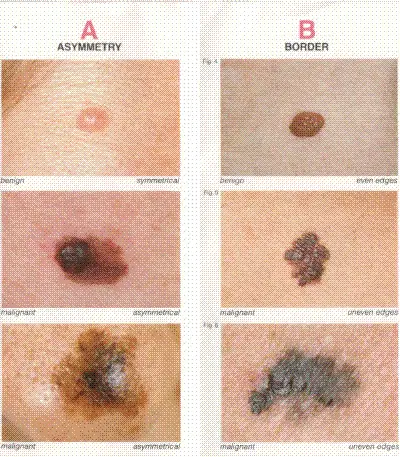
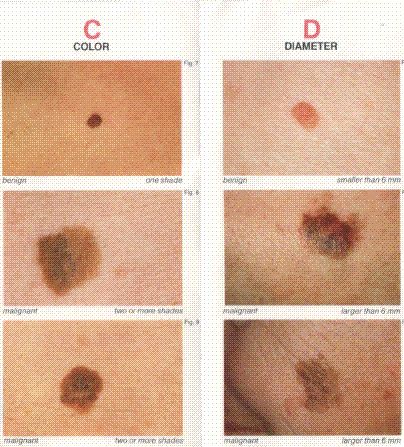
In self examination of your moles you need to inspect them for certain characteristics according to their size, color, shape and edges. These are known as the A-B-C-D’s of self examination. They stand for Asymmetry, Border, Color and Diameter.
melanoma pictures
Below are pictures of various types of moles characterized by the A-B-C-D descriptions. The top mole in each description is normal and the bottom two are malignant.
|
|
ASSYMMETRICAL meaning a line drawn thru them will not create equal matching halves. It is easy to see what this means by the examples above.
BORDER meaning that normal moles have even borders, but malignant moles frequently have uneven borders.
COLOR of brown, black or tan is normal but once a mole starts having different shades of color it becomes suspicious.
DIAMETER of common moles are usually the size of a pencil eraser head in diameter. Early malignant moles tend to be larger than that.
To further complicate the diagnosis of this malignant mole, there is a variant known as amelanotic melanoma. This is a melanoma with no pigment meaning it does not have a dark discoloration to it. Because of their lack of color these lesions are frequently diagnosed later in their growth meaning they tend to be deeper and more invasive. Fortunately, they do represent less than 5% of all melanomas.
They may be misdiagnosed as eczema, granulation tissue and paronychia (infected ingrown nail).
Typically, on the foot, amelanotic melanoma appears as a non-healing ingrown nail. Many paronychias are associated with a pyogenic granuloma which is a section of inflamed skin adjacent to the ingrown nail. These benign lesions are of a vascular makeup and tend to bleed profusely if cut. In most instances your doctor will cauterize the growth after he removes the offending ingrown nail. If the ingrown nail clears up, but the granuloma persists it should be brought to the attention of your doctor for possible biopsy.
When appearing on the skin, amelanotic malignant mole will present as a pink, reddish or even flesh colored. The diagnosis is generally not made until the lesion begins to grow or begins to itch or becomes painful or even begins to bleed. In many instances these lesions will be irritated from chronic shoe or clothing irritation.
As stated before it is important to examine all your moles on your body. Dermatologists recommend yearly examinations.
Interestingly, this year a study out of Rome, Italy found that people with higher serum levels of coenzyme Q (coq 10) has less incidence of melanoma and less metatastasis. (Journal American Academy of Dermatology, 2006 (ISSN:1097-6787)
As a last comment just because a mole somewhere on your body appears uncharacteristic it does not mean it is malignant but what it does mean is that you should have your doctor look at it immediately. A biopsy is the only way to determine the identity of the mole.
Frequently Asked Questions
REFERENCES
American American Academy of Dermatology
Black spot under toenail
Some weeks ago I spotted a black spot under my toenail. First I though it might be a mole, as I am prone to getting new very often. Today I was taking my socks off and noticed that a second one appeared almost next to it. Both spots seem quite symmetric, and I do not have any type of discomfort. Could this be some type of nail infection?
Response:
Hi Liz, Sitting on the other side of the internet, I cannot pretend to know exactly what those black spots under your toe nail actually are, but I will give you some insight and what you can do about them.
The majority of spots that occur underneath a nail are harmless. In most cases it is dry blood usually from some sort of trauma to the nail bed. The trauma does not have to be as severe as dropping something on your toe or someone stepping on it. In many instances it is from repetitive micro trauma such as wearing a shoe with a narrow toe box thus creating too much pressure on the nail and it starts to bleed underneath. If you happen to be athletic, that too can create this type of micro trauma.
Another very common cause of discoloration underneath a toe nail can be from fungus. I enlarged your pictures as best I could and it appears that the nail surrounding the two dark spots is discolored, which certainly may be fungus.
The third cause of discoloration under a nail bed is from a growth growing on the nail bed. This can range in most cases from a mole to a granuloma (which is scar tissue from irritation), all the way up to a skin cancer. So now we know it could be any number of possible conditions, again most of them harmless, but keeping in the back of our mind that there is possibility of a more serious problem.
Recommendation: Do nothing right away. Mark where the discoloration is today, relative to the skin on the side of the nail. Wait two months and see if the discoloration, both of them, grow forward, leaving no residual discoloration in the original spots. The reason I recommend this is because the majority of harmless discolorations under a nail will grow forward as the nail grows. Eventually the discolorations will be at the end of the nail where it can then be cut away.
Now, if the discoloration does not grow forward, there is a very good chance that there is a growth on the nail bed. Again, most of these are not serious problems, but at that point I would recommend seeing a doctor to have the nail removed to see what kind of growth may be on the nail bed. If the growth is suspicious it may have to be removed and biopsied. Although not common, skin cancers particularly melanoma can occur underneath a nail and this needs to be ruled out.
If you happen to live in the New York - New Jersey area and would like to visit our office
|
|
To make an appointment online or for directions to our office click Dr. Marc Mitnick.
DISCLAIMER: The purpose of this site is purely informational in nature. It is not intended to diagnose, treat or cure any medical condition. This information is not a substitute for advice from a medical professional. Please consult your healthcare provider for accurate diagnosis and treatment. The information presented here may be subject to errors and omissions.
SITE LAST UPDATED: September 2026


I've been doing some aggressive research lately (it's how I found your incredible website) and realize now that my symptoms are not consistant with the diagnosis.
Jennifer
Hunterville, NC
….after reviewing your amazing site (great for the avg. jill). So thank you very much!!!
Liesbeth
NY
I am really, really impressed with your plain-speak explanations for the various conditions.
Jacqueline
NJ
This was an extremely helpful site. I have an appointment on the 18th and your info. Was right on target…..
Jack
Fla
A well organized site containing much information written in a manner that the average reader can comprehend.
Jean
Ontario, Canada
I found your website and articles most interesting.
Andrew
Fla.
Thank you for a quick response. I think your site is the best information site on foot pain and I have viewed many.
Judy
(location unknown)
I came to your website, footspecialist.net via www.foot-pain explained .com which I think is also your website? I thought explanations for different types of problems were well addressed and thoughtfully stated for the patient in mind.
L.W.
New York
You have an amazing and extremely informative site. I enjoyed looking through all of the data and stats.
Yvette
Memphis, TN
Thanks again so much for the information in the article. Very interesting.
Anna
Scotland
Great article. I have had plantar fasciitis since I was in high school……..
J. Simmons
(location unknown)
Dear Dr. Mitnick, The orthotics arrived four days ago and I slipped them into my shoes immediately. I was skeptical as to the usefulness of the item, they really didn't look very exotic. I have to say though, after using them for just four days, I have experienced grand relief from my foot pain. Even the very first day, I was able to do a lot of work while on my feet with at least a 75% reduction of pain. It has only gotten better every day, and I go nowhere without my shoes with the orthotics. I had been experiencing extreme heel and sole pain for about six months and had to take extended breaks off my feet many times a day as well as regular doses of Ibuprofen. Since getting the orthotics, my life has returned to normal and I feel good again. Just wanted to say thanks for the recommendation for a very effective item, I had no idea what a change this item could affect.
Yours truly,
J.C. Forbes
Tennessee
Thanks for the Response, you hit it on the head.
Steve
Redondo Beach, CA
Thank you for your time and expertise in answering my question…..
LH
(location unknown)
First, thanks for putting together this website. Its the most informative site I have found dealing with foot problems. Last June I started having pain and swelling at …….
Joe
(location unknown)
First of all, thank you for having all this useful information available in one place. I've been through most of your website and based on my research, pain and evaluations I think I've narrowed things down quite a bit.
Pete M.
(location unknown)
Thank you for the best site I have found when researching foot pain.
Glenda B.
Madison, Alabama
Thanks for replying so quickly. I was a bit concerned. I think your website is great, and chock full of info.....
Carol
Denison, TX
Dr. Marc, Thank you so much for your reply which seemed to be right on. I have researched many sites but you put me on the right path to the possible answer. My foot pain may not rule the rest of my life after all! I believe I'll make a sign that reads, "THE END IS NEAR!" Thanks Very Much,
Dawn
West lafayette, IN
Dear sir...no doubt you get positive comments re your site...May I please be added to the list of your admirers. In all of my years of web surfing I would say your site is right there with the very best. Thank you for taking the time to write the terrific info you provide and for putting things into laymen terms for us mere mortals. I pray you have much on going success and thank you again for a deed well done. As for me I did not find much help for my symptoms and will continue on my quest. Were you anywhere in the South I would make and appointment...Thanks again dear sir...m.e.
Michael E.
Tampa, Florida 33624
Hi. This is a great site! I'm a healthy middle aged woman who is in good health, but.....
Kelly
Texas
Just a wee word of thanks for your wonderful website...It is a terrific service...Thank you for providing your knowledge and help...With highest regards, m ebeling
Michael D. Ebeling
Tampa, Florida 33624
Thanks for a most interesting website, which has helped a lot.
Steve
UK
Dear Dr.Mitnick
I usually do my research on the Mayo clinic website. I think your website is the most informative site I have found when researching foot pain.
I thank you for putting together this incredible website.
Regards,
Dragica W.
Edmonton,Canada
....I have been told that it is not hard enough to be cut off. Please help, I am not sure what to do now! THANKS FOR A WONDERFUL AND VERY HELPFUL SITE!
Roxy
South Africa
You have an unusually clear, informative and well-written website for laypersons. Thank you for that.
Matthew W.
Mansfield Ctr, CT
First, I'd like to thank you for all the information that you provide on your website and the opportunity to write to you.
Steve
Placentia, California
First, I want to let you know that you have the best web site I've found related to foot issues. (The only thing I had difficulty finding was the "ask a question" page.)
Unknown
Unknown location
I received the orthotics Monday afternoon and began wearing them Tuesday. After two days I would say that I have noticed a huge improvement in the discomfort I have been experiencing. My foot feels better than it has in months.
Ric J.
Unknown location
I greatly admire someone like you who would donate and dedicate so much time and effort to helping strangers with no compensation. Truly, it is uncommonly kind. And your site is so intelligently arranged.
Ron R.
Pacific Grove, CA
I used to work for a podiatrist (front desk) back during summers in college years ago, so I know the benefits of good care. Again, I want to thank you for an EXCELLENT website. It was so great to get to your site (top of google search) and actually find all the answers I needed EASILY and QUICKLY! Clearly you put a ton of work into it and I really appreciate it.
All the best,
Victoria
Alameda, California
By the way, millions of websites could use yours as a guideline on how to organize information and make the site user-friendly. Kudos to you!
Anonymous
Thank you for your very interesting and informative site!
Anonymous
Hi. I come to your site often looking for information. It is really informative and I appreciate it very much. I have RA and have been having considerable amount of foot pain...... Dee RN
Thanks very much for the wonderful informative site.
Catherine
New Zealand
Thank You for my answer! I have been schedule for a bone density scan, allingment, and I am in the process of getting orthotics made, and checking out the natural remedies. Thank again! What a great web site!
Sincerely
Josette
Yes I want both pair of orthotics. You don't have an option of ordering 2 at one time so I had to place the order twice. Thanks. My husband likes these and wants to put them in all of his shoes. (referring to Superstep orthotics)
Cindy H.
Arizona
I searched the internet everywhere for a clear description and illustration of my symptoms/problem. https://www.foot-pain-explained.com/ was where I ended my search with answers. If I lived in Jersey (left 30 years ago) and didn't live in Florida I would definetly make an appointment with Dr. Mitnick.
Thanks, Kathy
Florida
1st of all THANKS A LOT for your great site......
Anna
Poland
Thank you so much for your response. I will let you know how I am doing if you would like. Your website is awesome!
M P
South Carolina
Hello! I want to thank you for such an informative website! I found you based on my ankle pain search and am happy to realize that there may be a relatively simple cause and solution....
Natalie
unknown location
...Thanks for your fantastic service.
Gary
Arlington, VA
Thank you so very much, that would be much appreciated. I love those insoles, by the way. (referring to Superstep orthotics)
Kelly W.
San Clemente, CA
Dr Marc is fantastic...He seems to know exactly what you are feeling with the problems you are having. I wish he was in my home town so I could go to him with my problems!!!!!!!!!!!!!
Pam
location unknown
Great insights! Thanks Doc, you're the best.
Glen
location unknown
I have been experiencing foot pain of various sorts and am working to figure out what it is. I found this site and can only say BRAVO!! What an excellent site! The time it must have taken to put all this together must've been a daunting task! I am sure it has helped so many people. Thank you so very much for doing this.
Bre
location unknown
Dr. Mitnick, Thank you so much for your reply. I did let my physician know and they took an x-ray - all is well! Also, thank you for providing this wonderful site, it is very helpful with lots of useful information! I appreciate your gift of time! God bless.
anonymous
Dr. Mitnick, Thank you, you were 100% correct. The pain finally brought me to the ER. I spent 8 days in the hospital. The Doppler you spoke of was able to show that there was no pulse in that foot. This was an arterial clot that split and traveled throughout my leg. My leg was almost amputated. I am in rough shape but have all my parts intact!! You certainly know what you are talking about. Thank you for taking the time to answer. Yours Truly!
anonymous
Staying at home after hallux surgery I spend quite a lot of time seaching info useful for avoiding problems which might come back. Today I found your site and I am .... delighted it happened. It's one of the best site I found last days.
Anna
Poland
Thanks for taking time to read and answer so many questions. It is truly a public service!
Esh
Seattle, WA
I just wanted to say that I am very greatful for this website!!
Bonnie
location unknown
Also, and importantly, just want to praise this web site. Thorough and thoughtfully presented, it certainly must be of considerable assistance to anyone with a foot problem. Terrific -- and very interesting.I trust the address comes up easily for those seeking information.
Bill
New Jersey
Thanks so much for answering my question. You've been more help to me than my own Dr. has been lately. Thanks again....I hope to be able to walk without pain someday.
Debbie
location unknown
Wow, that is exactly the information needed!!! thank you thank you thank you!!! I appreciate this help so very much from Marc Mitnick DPM. Excellent information and help to improve One's life.
Chrissy
location unknown
Thanks so much for this website Dr. Marc! It is so nice that you have this ask the doctor feature..I'm sure I'ts been helpful for alot of people. I will try what you suggested and see if it helps...thanks again!
Tracy
Evansville, IA
Dear Marc
I just want to say thank you for the quick response and the good info. I find it amazing and a super nice thing that you do here by answering medical questions at no charge.
Russ W.
location unknown
Your website is full of a lot of helpful information, and I am very impressed with the time in which you responded to my post. Thank you again for your time and consideration in your response.
-Sunny.
location unknown
Thank you very much for the information, I will consider it. Excellent web site.
Jackie
San Diego, CA
Dr. Mitnick, Just want to say thank you so very much for your quick response and very informative reply! After reading what you had to say, I called the doctor's office and was able to get in and see him the same day as my injury. Toe was x-rayed and luckily, it is not broken or fractured. Very badly bruised and will probably lose the toe nail. And although my toe and toe nail are still very black and blue and very sore, they ARE both starting to feel a little better. So again, thank you! I am so very happy that I came across your website. The service you provide is outstanding and immeasurable!
Rivi,
Albany, NY
Thank you so much for all of your advice. In searching the web for people dealing with this same issue i can tell you that you are a Knight In shining Armor! If I lived in Jersey I would gladly be your Spokesperson. Hopefully next time you hear from me it will be good news. God Bless,
Jill S.
location unknown
THANK YOU SO VERY MUCH FOR YOUR TIME AND EFFORTS, YOU ARE SO VERY APPRECIATED. THANK YOU FOR ALL YOU DO.
Jackie
Whichita, KS
thanks again, this site is very helpful.
mark
Boston, MA
Like others have stated...This site is amazing and I am so thankful that it was created.
....Keep up what your doing. Your a life saver.
Michelle
Colorado
Thanks again for the information provided on your site. It's easy for non-medical folk to understand your writing, and helps provide better communication between patient and doctor.
annielou
Colorado
Wonderful advice
by: Anonymous
This is the best site for foot problem info.
Thank you for this information. This description fits my pain and inflammation behind my 2nd toe perfectly.
by: Max
location unknown
Again, I really appreciate that you responded to my inquiry, and that your mention of Parkinson's helped me to find my way to a diagnosis of this difficult to diagnose disease. Most patients see on average 16 doctors before they are diagnosed. I hope that you can help other people that ask for your expertise in the future.
Barb D.
Canada
I just wanted to say that I am very greatful for this website!! I have had a fusion in my rt foot and am finally getting a little bit better......
Bonnie
location unknown
Again, Thank you from the bottom of my heart for taking the time to answer my question....your an angel!
Nancie
Wisconsin
Thank you for your response. You have provided some great insight (to my question)....
Julie
location unknown
Thank-you so very much for responding so quickly and in such detail to my question!! I will give my surgeon a call today!! This website is terrific!!!! Thank-you again!
Renae
North Carolina
Many Thanks Dr Marc!
Thank you for your response. It sounds like a good plan to me. He did not cut the wart out first ...
KG
location unknown
Thanks again doc for having this website and we STILL need qualified Podiatrists in beautiful sunny Tampa Bay (Bradenton) Florida.
Bessie Mae
Florida
Dear Dr. Mitnick, Thank you so very much for taking your time to answer my question. You have greatly relieved my anxiety related to the continual tingly I feel in my feet. I will share your response with my podiatrist next week. God bless you for having this question and answer page on your website! Most gratefully,
Lynne T.
location unknown
Your webpage is excellent, I commend you on sharing your knowledge to the public.
Robert
New Jersey
Thank you. you were more detailed than what others have told me they finally called from the last xrays and my son is now in a cast for 2 weeks he did have a fracture that was not noticeable.
a mom
location unknown
I have read your website and I have to admit that I am amazed at all the information that is on here. I have learned more than the three years I have been going to several doctors that I have seen!!
Melody
Lenoir, NC
Thank you so much Doc for a quick and thorough response!
Rustam
Bellevue, WA
I cannot thank you enough for your response, opinion, and suggestions! I want you to know how much it means to me, and I'm sure everyone else who has ever asked you a question! I feel like you're a lifesaver and have empowered me to take a stronger role and stand up for myself and my feet!
Jodi
location unknown
Recent Articles


-
Vitamin D impact on health
Feb 06, 23 07:17 PM
Researchers are suggesting that the effectiveness of Vitamin D in fighting and preventing disease is predicated on a persons body mass index (BMI). The thinner the person the greater the positive impa… -
Foods to speed up healing
Feb 01, 23 02:41 PM
One of the best ways to help yourself heal faster after surgery is to eat well. Getting the proper nutrition will provide your body with the essentials it needs to promote healing. Here is a suggestio… -
Cancer and Type 2 Diabetes
Jan 25, 23 04:52 PM
An article revealing that older type 2 diabetics have a higher incidence of cancer then non-diabetics. It is suggested that cancer may surpass CVD as the number one cause of death in older diabetics. -
Does glucosamine or MSM reduce arthritis pain?
Jan 22, 23 01:41 PM
A good review of the possible benefits to taking glucosamine, chondroitin or MSM for arthritis. Always beware of the possible side effects of over the counter supplements. -
shin splints
Jan 18, 23 05:12 PM
A great review on the various causes of shin splints, along with treatment options. -
Whats new in skin cancer?
Jan 15, 23 08:32 PM
A presentation of newer skin protection combinations in an effort to better protect the skin from the hazards of sun exposure. -
Causes and risk factors of warts
Jan 14, 23 05:02 PM
A good review of the causes of warts and protective measures you can take to prevent developing them. -
Do chronic wounds need to be dressed daily?
Jan 11, 23 02:18 PM
Because of supply chain shortages as well as staffing shortages particularly during the pandemic, many institutions extended the time between dressing changes for chronic wounds. Is this really the be… -
Food choices that raise your risk of type 2 diabetes
Jan 08, 23 10:07 AM
A good review of how blood sugars can become elevated and the harm that can do. Certain food groups have a tendency to raise your blood sugars and should be avoided. -
Outcome stats from Scarf bunionectomy
Jan 03, 23 03:04 PM
The Journal of Foot and Ankle Surgery recently reported a meta analysis of outcomes in 1583 Scarf bunionectomies that met their inclusion criteria. Adverse events did not seem to be any better or wors…