brachymetatarsia
AUTHOR: Marc Mitnick DPMREVIEWED BY: Podiatric Medical Review Board
home --> brachymetatarsia
WHAT IS BRACHYMETATARSIA
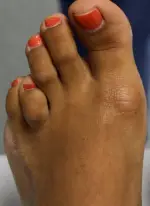
This is a congenital disorder attributed to the abnormal shortening of the metatarsal bone. Human beings are endowed with five elongated bones to which the toes are attached. The metatarsal bones basically make up the front part of the arch. This congenital disorder is more common in women than men (the estimated ratio is 1:20).
The problems caused by brachymetatarsia are two-fold:
- there is the cosmetic aspect which can be very troubling especially for women as the shortened metatarsal bone thus causes a “relative” shortening of the toe that is attached to the shortened metatarsal bone.
- there is the biomechanical consequence of brachymetatarsia which can alter one’s gait and in many cases cause pain when walking.
|
WHAT CAUSES BRACHYMETATARSIA
Brachymetatarsia is usually idiopathic (no known cause) or congenital (present at birth) in nature; at times it may also be caused by trauma to a metatarsal bone in its early stages of development. Trauma to the metatarsal bone may affect the growth plate of the metatarsal resulting in a shortened bone.
It has also been associated with more systemic congenital disorders such as Apert syndrome and Aarskog-Scott syndrome.
DIAGNOSIS OF BRACHYMETATARSIA
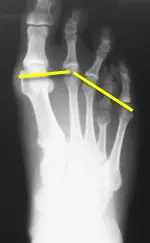
The deformity is easily diagnosed by xray and visual inspection of the affected foot. When foot specialists examine an xray of a foot one of the things we look at is the parabola, or arc that is formed by the heads of the metatarsal bones. In most people the second metatarsal bone is the longest with gradual shortening of the remaining bones, to form an arc. In brachymetarsia one of the metatarsal bones will be excessively short relative to the other metatarsal bones. The fourth metatarsal bone appears to be affected in the majority of cases. This is evidenced in the xray below.
|
TREATMENT OF BRACHYMETATARSIA
In this condition, there is no one universally applicable treatment, and consequently, it depends on the nature and severity of the affected metatarsal bone as well as other considerations such a patient’s gait pattern, activity level and shoe selection. In women who are required to wear dress attire on a regular basis this condition can become a real issue.
Nonsurgical treatment
Revolves around prescribing shoes containing extra depth to relieve the toe from the pressure and friction to which it gets exposed from the top of the shoe.
Customized orthotics is yet another option available to patients to mitigate the condition because one of the problems with a shortened metatarsal is that the metatarsal does not do its fair share of picking up body weight as a person ambulates and this may result in added pressure on the adjacent metatarsals. A prescription orthotic will generally have either a metatarsal pad or metatarsal bar built into it to take the excessive pressure off the adjacent metatarsals and aid in more evenly distributing body weight across the ball of the foot.
Surgical treatment
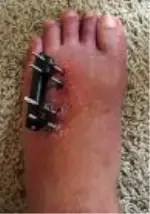
Surgery is highly specialized in nature. The goal of surgery is to lengthen the shortened metatarsal bone (and the surrounding soft tissue).
|
Gradual distraction osteotomy is a procedure where the shortened bone is cut straight across. Applied to either side of this bone cut is an external fixator device which as the name implies is located outside the foot.
Over a period of time, which is determined by the lengthening desired, the metatarsal bone is gradually stretched until the desired length is achieved. Depending on the amount of lengthening, a bone graft may also be inserted in order to maintain the desired length.
This procedure would not be attempted on those who have an exceptionally short metatarsal as there is only so much you can lengthen the metatarsal bone.
The goal of this surgery is to restore the parabola that we spoke of earlier so that all the metatarsal bones bear equal body weight, as well as better alignment of the toes.
This procedure is not without potential complications, the two most common being surgical failure and infection. Additionally, if the bone is over corrected mainly by too much plantarflexion or dorsiflexion , the bone will still not adequately pick up its share of body weight and may also adversely affect the alignment of the toe at the end of that metatarsal, causing the toe to either bend upwards or downwards in an excessive manner.
It appears, however, that most cases of brachymetatarsia require no treatment or at the very least, conservative care.
REFERENCES
International Foot and Ankle Foundation
Want more information? CLICK HERE

Recent Articles


-
Vitamin D impact on health
Feb 06, 23 07:17 PM
Researchers are suggesting that the effectiveness of Vitamin D in fighting and preventing disease is predicated on a persons body mass index (BMI). The thinner the person the greater the positive impa… -
Foods to speed up healing
Feb 01, 23 02:41 PM
One of the best ways to help yourself heal faster after surgery is to eat well. Getting the proper nutrition will provide your body with the essentials it needs to promote healing. Here is a suggestio… -
Cancer and Type 2 Diabetes
Jan 25, 23 04:52 PM
An article revealing that older type 2 diabetics have a higher incidence of cancer then non-diabetics. It is suggested that cancer may surpass CVD as the number one cause of death in older diabetics. -
Does glucosamine or MSM reduce arthritis pain?
Jan 22, 23 01:41 PM
A good review of the possible benefits to taking glucosamine, chondroitin or MSM for arthritis. Always beware of the possible side effects of over the counter supplements. -
shin splints
Jan 18, 23 05:12 PM
A great review on the various causes of shin splints, along with treatment options. -
Whats new in skin cancer?
Jan 15, 23 08:32 PM
A presentation of newer skin protection combinations in an effort to better protect the skin from the hazards of sun exposure. -
Causes and risk factors of warts
Jan 14, 23 05:02 PM
A good review of the causes of warts and protective measures you can take to prevent developing them. -
Do chronic wounds need to be dressed daily?
Jan 11, 23 02:18 PM
Because of supply chain shortages as well as staffing shortages particularly during the pandemic, many institutions extended the time between dressing changes for chronic wounds. Is this really the be… -
Food choices that raise your risk of type 2 diabetes
Jan 08, 23 10:07 AM
A good review of how blood sugars can become elevated and the harm that can do. Certain food groups have a tendency to raise your blood sugars and should be avoided. -
Outcome stats from Scarf bunionectomy
Jan 03, 23 03:04 PM
The Journal of Foot and Ankle Surgery recently reported a meta analysis of outcomes in 1583 Scarf bunionectomies that met their inclusion criteria. Adverse events did not seem to be any better or wors…
