heel pain, plantar fasciitis and bone spurs
AUTHOR: Marc Mitnick DPMREVIEWED BY: Podiatric Medical Review Board
home --> heel pain
WHAT CAUSES PLANTAR FASCIITIS
Heel pain including plantar fasciitis and bone spurs are one of the most common complaints seen in the foot. Plantar fasciitis is an inflammation of the large ligament on the bottom of the foot. Although most cases of plantar fasciitis occur near the heel, often described as sharp pain, this condition can be evident anywhere from the heel all the way to the ball of the foot.
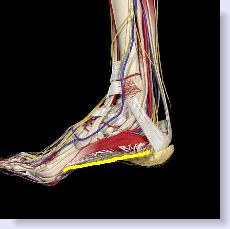
In order to feel the plantar fascial ligament, with one hand bend the big toe upwards, run your finger from your other hand along the bottom of the foot, you will feel a large cord like structure that runs from the ball of your foot to your heel. The purpose of this structure is to act like a bowstring in order to support the structure of your arch.
In the picture below, the yellow band represents the plantar fascial ligament. Notices how it attaches from the heel to the ball of the foot.
|
Factors that can cause plantar fasciitis
- foot structure- in general, high arched feet and feet that flatten out too much are more prone to this condition.
- excessive body weight
- wearing flimsy shoes like flip-flops or ballerina shoes, or even going barefoot.
- occupations that require a lot of standing especially on concrete floors and a lot of walking.
- physical activity such as participating in athletic activities.
Many authors consider the plantar fascial ligament to actually be a direct extension of the Achilles tendon. Once again refer to the diagram above.
People who exhibit an equinus or lack of dorsiflexion in the foot (the inability to bend the foot upwards beyond a 90 degree angle to the leg with their knee in a locked position) will be more inclined to suffer from plantar fasciitis. People who have a tight Achilles tendon are generally inclined to pronate more, to compensate for the Achilles tightness and this puts an added strain on the plantar fascial ligament.
Many women who suffer from plantar fasciitis will tell me that their heel feels better when they are in high heels. Why, because wearing a high heel reduces the tension on the Achilles tendon and thus reduces the tension on the plantar fascial ligament. If an equinus does exist, it must be addressed in the overall treatment plan because no matter what type of therapy your doctor may recommend, the tendency to overstretch the plantar fascial ligament will continue and so will the pain.
The problem with most foot symptoms unlike a hand injury for example, is that it is very hard to “rest” a foot in order to allow it to get better. So every time you take a step you are re-injuring an injured area and for that reason foot injuries can take a long time to heal, especially heel pain because every time you take a step you are putting pressure on the heel.
PLANTAR FASCIITIS SYMPTOMS
Most people relate a similar story:
- Pain in the heel when they first stand up after getting up in the morning or after being seated for a long period of time.
- As they walk around the pain will subside in varying degrees, but in almost all situations the pain will not completely disappear.
- As they begin to do a lot of walking, the pain will increase.
plantar fasciitis and heel spur
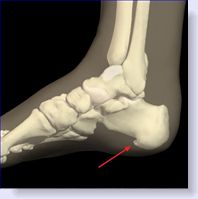
When there is excessive inflammation particularly at the insertion of the ligament into the heel bone, calcification can occur and you end up with what is routinely known as a heel spur which is the classic bone spur in the foot. One could argue that this is simply an exacerbation of the plantar fasciitis. In fact, in this day and age, seeing a heel spur on x-ray, does not change my treatment plan for any given patient.
Below is a picture of a true heel spur; a calcification of the plantar fascial ligament.
|
plantar fasciitis and other causes of heel pain
Additionally, when the pain in the heel seems to worsen the more you ambulate other problems may be present. In addition to the plantar fasciitis you may also be suffering from:
Heel bursitis
A heel neuroma, which is simply a pinched nerve that gets entrapped in the area of inflammation.
Tarsal tunnel syndrome
Lack of fat in the heel. The fat is supposed to act as a cushion, but some people either do not have enough fat, or as we age we lose some of the fat, and now the heel bone becomes bruised because there is not enough fat to protect it.
Plantar fascial tear- instead of being inflamed, the ligament may actually be torn.
heel fracture- a fracture of the calcaneus bone will cause heel pain that will worsen the more you ambulate.
It is essential that a well-trained foot specialist be consulted to rule out the cause of the heel pain. (These are the most common but not an all inclusive list of causes of heel pain).
Making the right diagnosis and eliminating the factors aggravating the heel pain are essential in alleviating the problem. If my patient happens to be very much overweight or wears very flimsy shoes, the chances of success in alleviating the problem are greatly diminished unless those issues are addressed.
REFERENCES
American Podiatric Medical Association
continue to plantar fasciitis treatments
Want more information? CLICK HERE
Para traducir esta pagina, ve al boton de traduccion de Google en las esquina superior derecha de la pagina


Recent Articles


-
Vitamin D impact on health
Feb 06, 23 07:17 PM
Researchers are suggesting that the effectiveness of Vitamin D in fighting and preventing disease is predicated on a persons body mass index (BMI). The thinner the person the greater the positive impa… -
Foods to speed up healing
Feb 01, 23 02:41 PM
One of the best ways to help yourself heal faster after surgery is to eat well. Getting the proper nutrition will provide your body with the essentials it needs to promote healing. Here is a suggestio… -
Cancer and Type 2 Diabetes
Jan 25, 23 04:52 PM
An article revealing that older type 2 diabetics have a higher incidence of cancer then non-diabetics. It is suggested that cancer may surpass CVD as the number one cause of death in older diabetics. -
Does glucosamine or MSM reduce arthritis pain?
Jan 22, 23 01:41 PM
A good review of the possible benefits to taking glucosamine, chondroitin or MSM for arthritis. Always beware of the possible side effects of over the counter supplements. -
shin splints
Jan 18, 23 05:12 PM
A great review on the various causes of shin splints, along with treatment options. -
Whats new in skin cancer?
Jan 15, 23 08:32 PM
A presentation of newer skin protection combinations in an effort to better protect the skin from the hazards of sun exposure. -
Causes and risk factors of warts
Jan 14, 23 05:02 PM
A good review of the causes of warts and protective measures you can take to prevent developing them. -
Do chronic wounds need to be dressed daily?
Jan 11, 23 02:18 PM
Because of supply chain shortages as well as staffing shortages particularly during the pandemic, many institutions extended the time between dressing changes for chronic wounds. Is this really the be… -
Food choices that raise your risk of type 2 diabetes
Jan 08, 23 10:07 AM
A good review of how blood sugars can become elevated and the harm that can do. Certain food groups have a tendency to raise your blood sugars and should be avoided. -
Outcome stats from Scarf bunionectomy
Jan 03, 23 03:04 PM
The Journal of Foot and Ankle Surgery recently reported a meta analysis of outcomes in 1583 Scarf bunionectomies that met their inclusion criteria. Adverse events did not seem to be any better or wors…
