tarsal coalition
AUTHOR: Marc Mitnick DPMREVIEWED BY: Podiatric Medical Review Board
home --> tarsal coalition
WHAT IS A TARSAL COALITION
This condition is an abnormal fusion of two bones located in the tarsal area of the foot. This tarsal area of the foot is also known as the hindfoot (rearfoot).

|
The red circle in the accompanying diagram represents the tarsal area. This area encompasses the talus, calcaneus, navicular and cuboid bones. The fusion is most common between the calcaneus-navicular bones and the talus-calcaneal bones. There are three types of fusions. The first is a bony fusion which is bone to bone fusion and tends to be the most rigid type of fusion. Next is a cartilage to cartilage fusion and last is a fusion of two bones through a fibrous union which is similar to scar tissue. These fusions either restrict or completely eliminate normal joint motion which generally forces the foot into a rigid flatfoot. This fusion of bone will ultimately adversely affect adjacent joints eventually leading to arthritis of those joints.
Most midfoot coalitions are of a congenital nature they can also be acquired by degenerative, inflammatory or infectious disease of the tarsal joint. Since the majority of these coalitions are of a congenital origin most people who have this condition are born with it, however, symptoms generally do not occur until the bones begin to mature generally around the ages of 9-16.
symptoms of tarsal coalition include
- varying degrees of pain when walking
- ankle pain
- a feeling of fatigue in the affected leg
- muscle spasms
- walking with a limp
- stiffness in the affected area
- a rigid flatfoot
- prolonged pain after simple ankle sprain, particularly in young
In order to limit pain the body will compensate by creating a muscle spasm of the peroneal muscles to limit motion of the hindfoot. The patient will tend to walk with the affected foot pointing outwards.
diagnosis of tarsal coalition
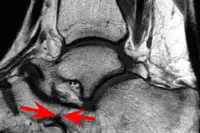
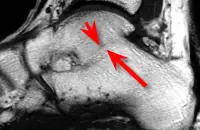
Diagnosis is generally made through clinical examination but is confirmed through x-rays, CT scans, or MRI (as shown in these two pictures). The first, on the left, is a calcaneal-navicular coalition, the second is a talo-calcaneal coalition).
 |
 |
HOW DO YOU TREAT TARSAL COALITION
The goal of conservative treatment is to relieve the symptoms and reduce motion at the fused joint.
conservative treatment
- Oral anti-inflammatory medication in an effort to reduce inflammation in the rear foot.
- Physical therapy to reduce inflammation and perhaps improve motion.
- Cortisone injections may also help reduce inflammation.
- Orthotics in an effort to reduce motion in the affected joint and keep the foot in a more neutral position.
- Immobilization through the use of a cast in an effort to reduce inflammation through rest and also to reduce any muscle spasm that may be present.
- Injection of local anesthesia in an effort to relax muscle spasm, usually performed prior to casting.
surgical treatment
Although symptoms of tarsal coalition may resolve with conservative care, there is always a chance of recurrence. When conservative care fails to alleviate the pain or the relief is only short lived then surgical intervention is warranted. Things that must be considered prior to surgery are the patient’s age, activity level, size of the coalition and adjacent pathology. The two types of surgery that are performed for tarsal coalition are resection, where the fused bone is removed in an effort to regain some kind of motion. The other type of surgery is arthrodesis where the coalition is actually further fused in an effort to reduce pain. The two procedures do sound contradictory but the choice of procedure is predicated on what the exact cause and type of coalition the patient presents with.
Generally, in younger individuals where there is no other adjacent pathology, resection of the tarsal coalition is the treatment of choice. This type of procedure attempts to restore some sort of motion within the joint. The problem here is that if the procedure fails then the patient is looking at a fusion which becomes more difficult when bone has already been removed.
In older individuals where there is associated pathology like arthritis and in those individuals who have had failed resections, arthrodesis or fusion of the two opposed bones is the only option.
If you are reading this section and are a candidate for tarsal coalition resection it is very important that you talk with your surgeon because additional surgical intervention is a possibility. The more severe your tarsal coalition, the greater the chance of additional surgery.
REFERENCES
Childrens Hospital of Philadelphia


Recent Articles


-
Vitamin D impact on health
Feb 06, 23 07:17 PM
Researchers are suggesting that the effectiveness of Vitamin D in fighting and preventing disease is predicated on a persons body mass index (BMI). The thinner the person the greater the positive impa… -
Foods to speed up healing
Feb 01, 23 02:41 PM
One of the best ways to help yourself heal faster after surgery is to eat well. Getting the proper nutrition will provide your body with the essentials it needs to promote healing. Here is a suggestio… -
Cancer and Type 2 Diabetes
Jan 25, 23 04:52 PM
An article revealing that older type 2 diabetics have a higher incidence of cancer then non-diabetics. It is suggested that cancer may surpass CVD as the number one cause of death in older diabetics. -
Does glucosamine or MSM reduce arthritis pain?
Jan 22, 23 01:41 PM
A good review of the possible benefits to taking glucosamine, chondroitin or MSM for arthritis. Always beware of the possible side effects of over the counter supplements. -
shin splints
Jan 18, 23 05:12 PM
A great review on the various causes of shin splints, along with treatment options. -
Whats new in skin cancer?
Jan 15, 23 08:32 PM
A presentation of newer skin protection combinations in an effort to better protect the skin from the hazards of sun exposure. -
Causes and risk factors of warts
Jan 14, 23 05:02 PM
A good review of the causes of warts and protective measures you can take to prevent developing them. -
Do chronic wounds need to be dressed daily?
Jan 11, 23 02:18 PM
Because of supply chain shortages as well as staffing shortages particularly during the pandemic, many institutions extended the time between dressing changes for chronic wounds. Is this really the be… -
Food choices that raise your risk of type 2 diabetes
Jan 08, 23 10:07 AM
A good review of how blood sugars can become elevated and the harm that can do. Certain food groups have a tendency to raise your blood sugars and should be avoided. -
Outcome stats from Scarf bunionectomy
Jan 03, 23 03:04 PM
The Journal of Foot and Ankle Surgery recently reported a meta analysis of outcomes in 1583 Scarf bunionectomies that met their inclusion criteria. Adverse events did not seem to be any better or wors…
