hammertoes
AUTHOR: Marc Mitnick DPMREVIEWED BY: Podiatric Medical Review Board
home --> hammertoes
WHAT ARE HAMMERTOES
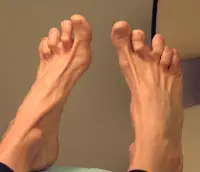
This is an arthritic condition of the toes. Mallet toes is a similar condition but with the deformity affecting a different joint in the toe. Below is an image of hammertoes, notice how the toes are bent and misaligned. These are the feet of a woman (LK) who has been an active runner for over 40 years.
|
WHAT CAUSES HAMMERTOES
Are Hammertoes Hereditary?
Certain types of foot structure, which of course are inherited, will lead to hammertoe formation.
High arched feet- People with very high arched feet are prone to hammertoe formation simply because the toes will begin to ride up over the metatarsal bones and then bend in such a manner to cause this deformity. This is heightened in people with high arched feet due to neurological disease.
Pronation- People who excessively pronate are subject to this problem simply because excessive flattening of the feet cause a muscle imbalance in the feet which causes the toes to bend.
Once the toes become crooked, they become difficult to fit in conventional shoes (the square peg into the round hole idea). They even become more difficult to fit into a high style women’s dress shoe. But, because society dictates it, many people particularly women will continue to ‘stuff’ their feet into the high style dress shoes.
What then occurs is that the toe deformities become more pronounced and more painful. As podiatrists we make a distinction between two types of hammertoes. Flexible hammertoes which are basically crooked toes that can be pulled straight (even though they will not stay that way) and rigid hammertoes that are bent in the crooked position and will not straighten out. This is of importance when discussing surgical correction.
When these crooked toes are forced into shoes on a regular basis the shoe begins to rub on the bony prominence of the toes. Anytime there is constant pressure on a bone, the bone tends to hypertrophy or enlarge. This further creates more friction between the bone and shoe. this excess pressure between bone and shoe will cause the following problems:
Joint pain- Since the toes are bent out of alignment this may cause a premature erosion of the joints of the toes resulting in arthritic pain.
Corns- This added friction will then cause a number of things to occur. The most common of which is the formation of a corn, or hard skin overlying the part of the toe that is constantly hitting the shoes. This corn can be on top of the toe, on either side of the toe generally from the result of overlapping toes, or at the end of the toe, depending on the degree of deformity.
Keep in mind that corns are formed by the body to protect the area from friction and pressure so in that sense they are a good thing. The problem arises when they get too thick and begin to hurt. So, the question asked of me is do all corns have to be treated? The short answer is only if they hurt. The smart money would be on trying to wear different shoes so that they do not begin to hurt, but shaving a corn simply to remove it when there is no pain involved seems like an effort in futility. As a side note, some people present with what they perceive to be a corn when in actuality it is a thickening of the skin overlying the bone. This skin is usually raised, maybe red in color and leathery in texture. This is not a corn nor can it be pared away; it will only bleed.
Bursitis- Along with the formation of corns the constant pressure will also cause the toe to become red and swollen in that area and very painful to touch. This is usually indicative of a bursitis formation.
Metatarsalgia- If the toe(s) is very rigid, the tendons on top of the toe may also become inflamed, plus because the crooked toes put so much retrograde or backward pressure on the metatarsal bones, it can also cause pain on the ball of the foot.
Poor fitting shoes- Shoes that are too narrow, too short or too shallow will contribute to the formation of this deformity. When a shoe does not fit properly it puts added pressure on the toes and that can cause the toes to deform. This does not occur over night, but long term use of very stylish shoes, for example, will cause this problem to occur.
TREATMENT OF HAMMERTOES
non-surgical treatment of hammertoes
Best shoes for hammertoes- to remove the pressure or friction on the toes which would be to change your shoe style into something more conservative, eg: boxier, wider and lower heel. You essentially have to wear shoes that will accommodate your toe deformity. I do not live in a vacuum and realize this is ridiculous advice for some of you reading this (You know who you are). But maybe a slight modification of your present shoes would be a good idea.
Pads for hammertoes- You can certainly try toe pads and there is no shortage of them on the market. I would strongly recommend you never use medicated corn pads (this is especially true for you diabetics). The medicated pads contain acid which attempts to eat away the corn. The problem is the acid does not know where to stop and can eat right through the skin creating an ulcer and invariably an infection.
If you use adhesive backed pads make sure you change them on a daily basis. Leaving an adhesive pad on your toes for days may also cause breakdown of the underlying skin with a resulting infection.
They also sell slings and other devices which you wear on your toes in an attempt to straighten them. The problem with these devices is that they may work while you actually wear them, but will never permanently straighten your toes and they also tend to take up a lot of space in the shoe.
Trimming corns-If the corn does hurt it can also be pared away. This is a very acceptable treatment and I have many patients who come in regularly for that type of care. Rarely does it cure the problem but many people will get months worth of relief.
I would be remiss if I did not mention the fact that nail salons are not the place to have corns pared away. A week does not go by that I do not see a patient with an infection as a result of having a corn or callus scraped away at a salon.
For those of you reading this who may be diabetic or have poor circulation or are a long term smoker, corns that get too big, that do not necessarily hurt, should be treated professionally on a periodic basis. The reason for this is that the corn puts so much pressure on the underlying skin it creates what is called pressure necrosis and the corn and underlying skin will breakdown and usually become infected. This is especially dangerous when the circulation to the toe is compromised.
Cortisone injection or anti-inflammatory medication- When your doctor makes a diagnosis of a bursitis on the toe this is a bit more difficult to treat. Usually a combination of anti-inflammatory medication along with orthopedic padding will give temporary relief. Many times a cortisone ijection into the toe can be very helpful, but keep in mind it can be a fairly painful injection. Click here for some more treatments for hammertoes.
Orthotics for hammertoes- Some people have asked me about the use of orthotics to treat hammertoes. The only argument I could make for the use of orthotics would be in situations where a person has the beginnings of hammertoe development and exhibits either a very pronated foot or a very high arched foot. Better control of the underlying foot structure with an orthotic may prevent a worsening of a hammertoe deformity but certainly will not straighten an existing deformity, particularly a rigid hammertoe.
Conversely, if you eventually undergo hammertoe surgery and have an underlying foot structure that predisposes you to hammertoe formation, then an orthotic would be recommended to help prevent recurrence. It should be noted that this would be predicated on the type of surgical correction you undergo.
surgical care
OK, so you are not ready to stop wearing those killer heels, periodic scraping of the corns either gives you minimal relief or you do not want to see your podiatrist once a month for the rest of your life, so what do you do?
At this point you have to entertain surgical correction. When we evaluate hammertoe surgery we look at the architecture or alignment of all the toes, even the ones that do not hurt. If a hammertoe is overcorrected it can then cause problems with the adjacent toes that may not presently hurt.
The following short (13 second) video demonstrates the classic hammertoe surgical procedure, where a piece of bone is removed in order to allow the toe to sit straight.
There a few different surgical procedures available to correct hammertoe deformities most involving bone remodeling but some can be nothing more than soft tissue procedures done in an effort to realign the toe in question. It is important to discuss your options with a qualified foot specialist.
CONTINUE....MORE SURGICAL PROCEDURES FOR HAMMERTOES
REFERENCES

Recent Articles


-
Vitamin D impact on health
Feb 06, 23 07:17 PM
Researchers are suggesting that the effectiveness of Vitamin D in fighting and preventing disease is predicated on a persons body mass index (BMI). The thinner the person the greater the positive impa… -
Foods to speed up healing
Feb 01, 23 02:41 PM
One of the best ways to help yourself heal faster after surgery is to eat well. Getting the proper nutrition will provide your body with the essentials it needs to promote healing. Here is a suggestio… -
Cancer and Type 2 Diabetes
Jan 25, 23 04:52 PM
An article revealing that older type 2 diabetics have a higher incidence of cancer then non-diabetics. It is suggested that cancer may surpass CVD as the number one cause of death in older diabetics. -
Does glucosamine or MSM reduce arthritis pain?
Jan 22, 23 01:41 PM
A good review of the possible benefits to taking glucosamine, chondroitin or MSM for arthritis. Always beware of the possible side effects of over the counter supplements. -
shin splints
Jan 18, 23 05:12 PM
A great review on the various causes of shin splints, along with treatment options. -
Whats new in skin cancer?
Jan 15, 23 08:32 PM
A presentation of newer skin protection combinations in an effort to better protect the skin from the hazards of sun exposure. -
Causes and risk factors of warts
Jan 14, 23 05:02 PM
A good review of the causes of warts and protective measures you can take to prevent developing them. -
Do chronic wounds need to be dressed daily?
Jan 11, 23 02:18 PM
Because of supply chain shortages as well as staffing shortages particularly during the pandemic, many institutions extended the time between dressing changes for chronic wounds. Is this really the be… -
Food choices that raise your risk of type 2 diabetes
Jan 08, 23 10:07 AM
A good review of how blood sugars can become elevated and the harm that can do. Certain food groups have a tendency to raise your blood sugars and should be avoided. -
Outcome stats from Scarf bunionectomy
Jan 03, 23 03:04 PM
The Journal of Foot and Ankle Surgery recently reported a meta analysis of outcomes in 1583 Scarf bunionectomies that met their inclusion criteria. Adverse events did not seem to be any better or wors…
