edema
AUTHOR: Marc Mitnick DPMREVIEWED BY: Podiatric Medical Review Board
home --> edema
swelling of the feet and ankles
WHAT IS EDEMA
This is a condition of abnormally large fluid volume in the circulatory system or in tissues between the body's cells interstitial spaces . In this condition, either too much fluid moves from the blood vessels into the tissues, or not enough fluid moves from the tissues back into the blood vessels. The management of patients with swelling is directed toward the treatment of the underlying medical condition. This is important because excess water retention as it relates to the feet and ankles may be caused by a number of factors and it is very important to know the cause of this condition before it can be properly treated.
This discussion, of course, will be limited to edema of the feet and ankles but it is also possible to have water retention in other parts of the body.
|
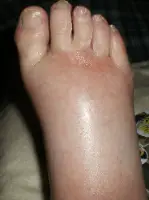
Water retention in the feet, ankles and lower leg is usually described as swelling where the foot appears "bloated". The skin is therefore stretched and in some cases can be shiny as a result. With this swelling there will also be a loss of visual skin structures like the tendons on the top of the foot.
WHAT CAUSES EDEMA IN THE FOOT AND ANKLE
swelling occurring in both feet
- venous insufficiency, probably the most common cause where the valves that pump blood back up to the heart become incompetent over time, so the blood attempts to travel back up to the heart, but falls back down and settles in the foot and ankles. By the end of the day, the feet and ankles will be swollen, but upon arising in the morning, there is usually minimal to no edema.
- excessive humidity, this too will be worse at the end of the day and much improved first thing in the morning.
- standing too long without much movement
- sitting too long where there is too much pressure on the veins in the back of the thigh. More common in the elderly
- congestive heart failure
- lung disease
- kidney disease
- thyroid disease
- pregnancy
- people with salt sensitivity
- medications including vasodilators which act to open up arteries, which bring more blood down to the extremities, calcium channel blockers which are used for high blood pressure, estrogens and NSAID's such as Aleve, Motrin or Advil along with the prescription versions all may cause excess water retention. This is particularly true in older individuals and that is why they should be avoided in prolonged doses in those populations.
swelling occurring in one foot (unilateral edema)
- usually not from a systemic illness or from medication
- trauma to the foot or ankle
- arthritic flare up of a joint which will usually mean a localized swelling in the foot or ankle
- deep venous thrombosis (dvt) which most likely is occurring in the calf. This is potentially the most dangerous cause of unilateral swelling and needs immediate medical attention.
- gout, which is classified as an arthritic flare up will cause localized swelling.
- infection in the foot may also cause localized swelling.
- foot and ankle surgery will also cause swelling. After surgery, it is normal for the foot to swell as the body is increasing the blood flow to the surgical site in an effort to facilitate healing.
- lymphedema which is an abnormal removal of interstitial fluid (fluid between cells) through a problem with the lymphatic system. This is usually due to an obstruction of a lymph node. Can also occur in both feet..
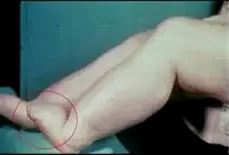
In lymphedema there are instances where the feet and toes are not swollen and the disease affects primarily the leg. This type of manifestation presents with a loss of calf contour and the leg can be described as stove pipe in appearance.
When the foot is affected the appearance typically takes on what is described as a "buffalo hump" where the top portion of the foot is excessively swollen relative to the rest of the foot.
4 stages of lymphedema
Stage 0-no clinical appearance of lymphedema, mild pitting edema will usually resolve over-night. Lymphedema is diagnosed through vascular testing.
Stage 1-mild pitting edema which usually resolves over-night.
Stage 2-is divided into early stage and late stage. In early stage there is usually pitting edema while in late stage there is no longer pitting but rather brawny edema along with skin changes. Swelling is no longer relieved with elevation.
Stage 3-Elephantiasis characterized by severe non-pitting edema, fibrosis of skin, formation of papillomas and tumors, excessive fat deposition (which may be mistaken for fluid retention), ulceration of skin, as well as cobblestoning of skin.
Excess water retention is usually classified by its severity. The most severe form of swelling is known as pitting edema, also known as brawny edema. You push your finger into the swollen area and the indentation remains after you remove your finger. This is an indication that the swelling is severe and requires medical attention. It is also a sign that this has become a chronic condition.
The depth of the "crater" that is created when you push your finger into the swollen area determines the grade or severity of the swelling. Grade 1 is the least amount of water retention, while Grade 4 is the severest amount.
Non-pitting edema where there is no indentation is usually seen in acute edema, such as seen in a sprained ankle.
TREATMENT FOR EDEMA
The earlier treatment is initiated for this condition, the better the chances of eliminating it or at least controlling it. As stated previously, the most important thing is to accurately diagnose the cause of excess swelling. The problem with ignoring this problem is that it might be a sign of a more serious problem but even if it is not, once a foot has been swollen for a long period of time you end up with brawny edema which is basically permanent swelling that will never subside.
TREATMENT:
- identify and control the underlying cause and not just treat the symptoms
- diuretics or water pills which help the body eliminate the excess fluid
- elevation of the feet usually reserved for simple cases of swelling
- walking which will force the leg muscles to contract and help return the blood to the heart
- compression stockings which come in various pressure gradients and help prevent fluid build up. They need to be applied first thing in the morning.
- compression pumps which are usually reserved for severe swelling like lymphedema in chronically ill patients.
- drainage of a localized abscess will reduce swelling in infections.
REFERENCES
Para traducir esta pagina, ve al boton de traduccion de Google en las esquina superior derecha de la pagina
Want more information? CLICK HERE


Recent Articles


-
Vitamin D impact on health
Feb 06, 23 07:17 PM
Researchers are suggesting that the effectiveness of Vitamin D in fighting and preventing disease is predicated on a persons body mass index (BMI). The thinner the person the greater the positive impa… -
Foods to speed up healing
Feb 01, 23 02:41 PM
One of the best ways to help yourself heal faster after surgery is to eat well. Getting the proper nutrition will provide your body with the essentials it needs to promote healing. Here is a suggestio… -
Cancer and Type 2 Diabetes
Jan 25, 23 04:52 PM
An article revealing that older type 2 diabetics have a higher incidence of cancer then non-diabetics. It is suggested that cancer may surpass CVD as the number one cause of death in older diabetics. -
Does glucosamine or MSM reduce arthritis pain?
Jan 22, 23 01:41 PM
A good review of the possible benefits to taking glucosamine, chondroitin or MSM for arthritis. Always beware of the possible side effects of over the counter supplements. -
shin splints
Jan 18, 23 05:12 PM
A great review on the various causes of shin splints, along with treatment options. -
Whats new in skin cancer?
Jan 15, 23 08:32 PM
A presentation of newer skin protection combinations in an effort to better protect the skin from the hazards of sun exposure. -
Causes and risk factors of warts
Jan 14, 23 05:02 PM
A good review of the causes of warts and protective measures you can take to prevent developing them. -
Do chronic wounds need to be dressed daily?
Jan 11, 23 02:18 PM
Because of supply chain shortages as well as staffing shortages particularly during the pandemic, many institutions extended the time between dressing changes for chronic wounds. Is this really the be… -
Food choices that raise your risk of type 2 diabetes
Jan 08, 23 10:07 AM
A good review of how blood sugars can become elevated and the harm that can do. Certain food groups have a tendency to raise your blood sugars and should be avoided. -
Outcome stats from Scarf bunionectomy
Jan 03, 23 03:04 PM
The Journal of Foot and Ankle Surgery recently reported a meta analysis of outcomes in 1583 Scarf bunionectomies that met their inclusion criteria. Adverse events did not seem to be any better or wors…
