cuboid syndrome
AUTHOR: Marc Mitnick DPM
home --> cuboid syndrome
WHAT IS CUBOID SYNDROME
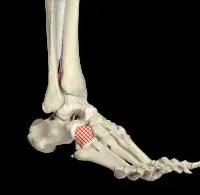
This condition, also known as a subluxed cuboid is a disruption of the cuboid bone which lies on the outside of the foot, in its alignment with the adjacent bones. The disruption of this bone causes irritation to the surrounding soft tissue structures that attach to it.
|
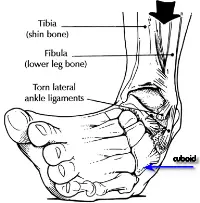
This is a condition seen more often in athletes due to the excessive pressure and motion that they put their feet through. It is thought that the most common cause of a subluxed cuboid is due to excessive inversion of the ankle (see drawing, below right) or excessive plantarflexion of the foot. Certain athletes are seen at greater risk of developing this syndrome. Male ballet dancers are very prone to this injury due to repetitive jumps, while female ballet dancers are prone to a subluxed cuboid as a result of the second most cause of this condition, overuse injuries, where there is a repetitive microtrauma to the ligaments attaching to the cuboid bone.
|
SYMPTOMS OF CUBOID SYNDROME
What does cuboid syndrome feel like
- pain that develops rapidly after an inversion sprain
- in some instances develops gradually, after a prolonged period of time, following an inversion sprain
- pain is usually directly over the cuboid bone
- pain may also travel underneath the foot into the arch
- surrounding structures may also be painful
- pain may be present weight bearing and nonweightbearing but certainly it becomes more difficult to walk
- The lateral side of the foot will exhibit swelling, may be black and blue (ecchymosis), and there may also be some redness, all signs of inflammation
WHAT CAUSES CUBOID SYNDROME
Factors that can cause cuboid syndrome include:
- running on uneven surfaces, particularly banked streets where the foot is forced into supination. On a banked street this would involve the foot that is further from the center of the street (closer to the curb).
- excessive weight, like most foot problems, too much body weight puts excessive strain on the feet and ankles.
- worn out athletic shoes, shoes that do not adequately support the foot can aggravate this problem.
- feet that exhibit too much motion at the level of the subtalar joint which creates excessive inversion or everstion.
DIAGNOSIS OF CUBOID SYNDROME
The diagnosis cannot be made by use of x-ray or MRI because the subluxation is so minor that imaging studies would be of little value, however at least an x-ray is indicated to rule out other pathology particularly fracture.
Many doctors advocate the use of a CT scan (computerized tomography) when investigating the possibility of a fracture of the cuboid as it seems a CT scan better outlines the cortex (outer layer of bone) than an MRI or x-ray.
Quite often this condition may be confused with peroneal tendonitis and fifth metatarsal base fractures.
CUBOID SYNDROME TREATMENT
conservative treatment
the primary treatment is manipulation of the cuboid bone back into place. In many instances relief from pain is immediate.
Other forms of treatment include:
- physical therapy
- taping the foot in a certain manner to force the cuboid back into position. This can be accomplished through low-dye strapping or KT taping.
- an orthotic with a built in cuboid pad can be very helpful in maintaining the position of the cuboid
CUBOID FRACTURE
in cases of simple non-displaced fractures where there is essentially a crack in the bone but no separation of the two ends of the bone, initial treatment consists of immobilization with non-weightbearing.
I recommend non-weightbearing simply because when bearing weight, the pressure exerted on the outside of the foot, even in a cast, can be enough to not allow the fracture to heal.
A bone stimulator may also be used to aid in healing.
surgical treatment
In cases where immobilization does not remedy the situation surgery may be indicated. In simple cuboid fractures, in many instances a bone fusion is performed between the calcaneus (the bone behind the cuboid) and the cuboid bone itself. This fusion creates better stabilization of the cuboid bone thus reducing pain.
In cases of cuboid fracture from trauma, the bone itself may require insertion of hardware to stabilize it as well as fusion to the calcaneus.
REFERENCES
Journal of the American Podiatric Medical Association
Want more information? CLICK HERE


Recent Articles


-
Vitamin D impact on health
Feb 06, 23 07:17 PM
Researchers are suggesting that the effectiveness of Vitamin D in fighting and preventing disease is predicated on a persons body mass index (BMI). The thinner the person the greater the positive impa… -
Foods to speed up healing
Feb 01, 23 02:41 PM
One of the best ways to help yourself heal faster after surgery is to eat well. Getting the proper nutrition will provide your body with the essentials it needs to promote healing. Here is a suggestio… -
Cancer and Type 2 Diabetes
Jan 25, 23 04:52 PM
An article revealing that older type 2 diabetics have a higher incidence of cancer then non-diabetics. It is suggested that cancer may surpass CVD as the number one cause of death in older diabetics. -
Does glucosamine or MSM reduce arthritis pain?
Jan 22, 23 01:41 PM
A good review of the possible benefits to taking glucosamine, chondroitin or MSM for arthritis. Always beware of the possible side effects of over the counter supplements. -
shin splints
Jan 18, 23 05:12 PM
A great review on the various causes of shin splints, along with treatment options. -
Whats new in skin cancer?
Jan 15, 23 08:32 PM
A presentation of newer skin protection combinations in an effort to better protect the skin from the hazards of sun exposure. -
Causes and risk factors of warts
Jan 14, 23 05:02 PM
A good review of the causes of warts and protective measures you can take to prevent developing them. -
Do chronic wounds need to be dressed daily?
Jan 11, 23 02:18 PM
Because of supply chain shortages as well as staffing shortages particularly during the pandemic, many institutions extended the time between dressing changes for chronic wounds. Is this really the be… -
Food choices that raise your risk of type 2 diabetes
Jan 08, 23 10:07 AM
A good review of how blood sugars can become elevated and the harm that can do. Certain food groups have a tendency to raise your blood sugars and should be avoided. -
Outcome stats from Scarf bunionectomy
Jan 03, 23 03:04 PM
The Journal of Foot and Ankle Surgery recently reported a meta analysis of outcomes in 1583 Scarf bunionectomies that met their inclusion criteria. Adverse events did not seem to be any better or wors…