high ankle sprain
AUTHOR: Marc Mitnick DPM
home --> high ankle sprain
(syndesmotic sprain)
WHAT IS A HIGH ANKLE SPRAIN
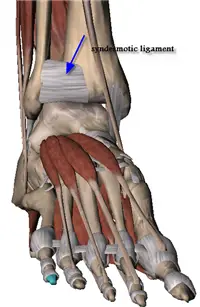
This type of ankle sprain is damage just above the ankle joint, unlike typical ankle sprains which affect the ligaments that attach the ankle bone into the foot. In the case of this type of sprain, there is damage to the ligaments (syndesmotic ligaments) that connects the two leg bones together, the tibia and fibula bones, that together form the top of the ankle joint. The specific ligament is called the anterior inferior tibio-fibula ligament.
The purpose of this ligaments is two fold. One is to keep the fibula bone attached to the lower leg in an effort to form the ankle joint. Additionally, this ligament has some "give" to it so that it expands when the foot is dorsiflexed (lifted upward) in an effort to allow the talus bone of the foot to go through its full range of motion (ankle joint motion). A high ankle sprain is generally a more serious injury then the typical ankle sprain and in most cases takes longer to heal.
|
HOW DOES THIS TYPE OF SPRAIN OCCUR
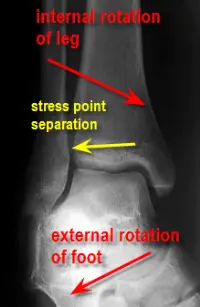
The mechanism that creates this injury is the twisting of the foot outward while the lower leg is twisting inward. This causes a torquing of the tibia and fibula bones putting tremendous stress on the syndesmotic ligament to the point where the ligament is damaged or even torn.
Any one may suffer this type of sprain but it is more often than not seen in athletes who have their foot planted in the ground and the impact of someone hitting them like in football or soccer causes the excessive twisting motion. Typically, there will be pain, swelling and eccymosis (black and blue) on the outside of the ankle as well as the front of ankle just above the foot. Rarely do we see pain on the front of the ankle in simple ankle sprains.
|
- X-rays are taken but it can be difficult to see any change in the position of the tibia and fibula bones.
- Stress view x-ray- If a high ankle fracture is suspected a "stress view" may be taken where the mechanism of injury is re-created in an effort to see if there is any widening between the two bones.
- MRI- In cases where it is still difficult to make a diagnosis, an MRI may be indicated to determine if there is damage to the syndesmotic ligament.
- CT scan (computed tomography) is also helpful as it can demonstrate a widening between the tibia and fibula bones indicating damage to the syndesmotic ligament.
- The Squeeze Test for high ankle sprain is a classic test for this type of sprain, whereby you squeeze the middle of the lower leg from side to side. If there is damage to the syndesmotic ligament then there will be pain.
- Klieger's maneuver involves externally rotating the foot relative to the leg. In a high ankle sprain, this too should cause discomfort.
TREATMENT FOR HIGH ANKLE SPRAIN
Conservative- Treatment of high ankle sprain is along the same lines as treatment for a simple ankle sprain, however, it is not uncommon for this type of sprain to take much longer to heal. The standard treatment of R.I.C.E. (rest, ice, compression and elevation) is in order, but the compression component usually requires a walking boot or cast to better stabilize the tibia and fibula bones.
In more severe cases the patient may have to be non-weightbearing on the affected foot. One of the reasons healing may take longer is due to the chance of misdiagnosis where the diagnosis of lateral or medial ankle sprain is made while in actuality it is a high ankle sprain.
In severe injuries it may take upwards to 8-12 weeks for complete healing and a return to sports. Less time will be required to just return to normal walking activities.
Physical therapy for high ankle sprain is also very useful for two reasons:1. to facilitate healing and 2. to prevent muscle atrophy.
Surgery- In those cases where pain remains unresolved after a legitimate period of time, surgical intervention is considered where in some cases the ligament is surgically repaired and in other cases a screw may be placed between the tibia and fibula bone to stabilize the stress that it being created during gait.
REFERENCES
American Podiatric Medical Association
Want more information? CLICK HERE


Recent Articles


-
Vitamin D impact on health
Feb 06, 23 07:17 PM
Researchers are suggesting that the effectiveness of Vitamin D in fighting and preventing disease is predicated on a persons body mass index (BMI). The thinner the person the greater the positive impa… -
Foods to speed up healing
Feb 01, 23 02:41 PM
One of the best ways to help yourself heal faster after surgery is to eat well. Getting the proper nutrition will provide your body with the essentials it needs to promote healing. Here is a suggestio… -
Cancer and Type 2 Diabetes
Jan 25, 23 04:52 PM
An article revealing that older type 2 diabetics have a higher incidence of cancer then non-diabetics. It is suggested that cancer may surpass CVD as the number one cause of death in older diabetics. -
Does glucosamine or MSM reduce arthritis pain?
Jan 22, 23 01:41 PM
A good review of the possible benefits to taking glucosamine, chondroitin or MSM for arthritis. Always beware of the possible side effects of over the counter supplements. -
shin splints
Jan 18, 23 05:12 PM
A great review on the various causes of shin splints, along with treatment options. -
Whats new in skin cancer?
Jan 15, 23 08:32 PM
A presentation of newer skin protection combinations in an effort to better protect the skin from the hazards of sun exposure. -
Causes and risk factors of warts
Jan 14, 23 05:02 PM
A good review of the causes of warts and protective measures you can take to prevent developing them. -
Do chronic wounds need to be dressed daily?
Jan 11, 23 02:18 PM
Because of supply chain shortages as well as staffing shortages particularly during the pandemic, many institutions extended the time between dressing changes for chronic wounds. Is this really the be… -
Food choices that raise your risk of type 2 diabetes
Jan 08, 23 10:07 AM
A good review of how blood sugars can become elevated and the harm that can do. Certain food groups have a tendency to raise your blood sugars and should be avoided. -
Outcome stats from Scarf bunionectomy
Jan 03, 23 03:04 PM
The Journal of Foot and Ankle Surgery recently reported a meta analysis of outcomes in 1583 Scarf bunionectomies that met their inclusion criteria. Adverse events did not seem to be any better or wors…