ganglion cyst
AUTHOR: Marc Mitnick DPMREVIEWED BY: Podiatric Medical Review Board
home --> ganglion cyst
WHAT IS A GANGLION CYST
It essentially is a benign tumor, or lump that can technically occur anywhere on the body but are most prevalent on the hands, but also very common on the feet. It is basically a sac filled with fluid that arises from either a joint (space between two bones) or from a tendon (structure that attaches a muscle into bone). There is a theory that it is nothing more than the result of herniation of a tendon, or synovium which makes up a joint.
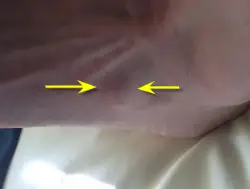
A dorsal ganglion cyst which occurs on top of the foot is the most common location in the foot.
|
These cysts are also known as bible cysts or sometimes Gideon cysts because years ago the recommended treatment was to smash the growth with a book in order to break it up and even the poorest of families owned a bible.
The growth is more common in women with 70 percent of ganglions occurring in people between 20-40 years of age. On rare occasions they have been known to occur in children younger than 10 years of age. About 4% of them occur on the feet.
WHAT CAUSES A GANGLION CYST TO FORM
Ganglions usually occur due to a weakness in the covering of a tendon or joint space. Everyday trauma such as motion of a tendon over a bony prominence or pressure from a shoe on a tendon or joint can cause a weakness in the covering with a subsequent swelling of liquid into a confined space thus causing the “lump” to form.
symptoms of ganglion cyst
The growth may be moderately firm or soft, depending on the fluid content or whether the outer part of the sac bears calcification. The fluid itself is a colorless gel similar in appearance to k-y jelly. Pressure on the ganglion cyst itself rarely causes pain; any pain is from pressure to adjacent sites.
A diagnosis of a ganglion is usually made on clinical examination based on location of the growth and relevant history. An x-ray may be taken to rule out a bone spur as the aggravating factor behind the formation of the cyst. If there is any question as to the diagnosis an MRI or diagnostic ultrasound may be performed.
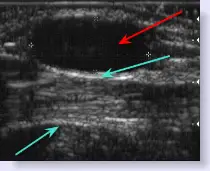
The picture below is that of a diagnostic ultrasound. The area in between the two blue arrows represents the tendon. Above the tendon is a black oval area (red arrow), which represents the ganglion. Since the cyst is made up of liquid it creates the least amount of “bounce” from the ultrasound waves and results in a black mass.
|
TREATMENT FOR GANGLION CYST
Once a mass is diagnosed as a ganglion cyst it may be left alone if it is not painful or causing problems with shoes. As stated previously sometimes these growths will spontaneously disappear. However, if there is any pain associated with the growth or the patient does not like the unsightly appearance, drainage is the simplest approach.
ganglion cyst aspiration
A large bore needle is inserted into the growth with local anesthesia and perhaps cortisone in an effort to burst and drain the growth. If the content of the ganglion is not too viscous this can be easily done; sometimes however, it is not possible to drain the cyst.
Once drained, a compression dressing is worn over the site for a period of time in an attempt to reduce recurrence. Having said that, there is a 70 percent recurrence rate with this form of treatment, but the upside is that the procedure can be repeated again since it is a relatively painless procedure.
ganglion cyst surgery
If the growth is a source of irritation for the patient then surgical excision is necessary keeping in mind that there is even a recurrence rate with this form of treatment. The problem with surgical excision is that sometimes the cyst will burst while attempting to remove it. Although the sac will still be present it becomes difficult to determine where the “stalk” or origin of the cyst came from. It is important to remove this stalk in an effort to prevent recurrence.
Aside from the possibility of recurrence, surgical complications are limited with stiffness in the surgical area being a primary complaint.
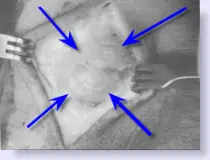
Below is a picture of a ganglion cyst that has just been identified prior to removal. It is the round glistening lesion located in between the blue arrows. The next picture is that of the cyst after its removal. In this instance the cyst was removed intact.
|

|
Surgical excision is an outpatient procedure with a quick recovery time frame.
There really is no preventative care for these cysts due to their spontaneous nature. It is no longer recommended to try and break them up by smashing them with a book as this can cause additional trauma to the area. Warm heat compresses might make the cyst and surrounding area feel a little more comfortable but will not rid you of the growth.
Once a diagnosis of ganglion cyst is made and more potentially dangerous growths have been ruled out, you can just leave the growth alone unless it bothers you.
REFERENCES
American College of Foot and Ankle Surgeons
Want more information? CLICK HERE
Para traducir esta pagina, ve al boton de traduccion de Google en las esquina superior derecha de la pagina


Recent Articles


-
Vitamin D impact on health
Feb 06, 23 07:17 PM
Researchers are suggesting that the effectiveness of Vitamin D in fighting and preventing disease is predicated on a persons body mass index (BMI). The thinner the person the greater the positive impa… -
Foods to speed up healing
Feb 01, 23 02:41 PM
One of the best ways to help yourself heal faster after surgery is to eat well. Getting the proper nutrition will provide your body with the essentials it needs to promote healing. Here is a suggestio… -
Cancer and Type 2 Diabetes
Jan 25, 23 04:52 PM
An article revealing that older type 2 diabetics have a higher incidence of cancer then non-diabetics. It is suggested that cancer may surpass CVD as the number one cause of death in older diabetics. -
Does glucosamine or MSM reduce arthritis pain?
Jan 22, 23 01:41 PM
A good review of the possible benefits to taking glucosamine, chondroitin or MSM for arthritis. Always beware of the possible side effects of over the counter supplements. -
shin splints
Jan 18, 23 05:12 PM
A great review on the various causes of shin splints, along with treatment options. -
Whats new in skin cancer?
Jan 15, 23 08:32 PM
A presentation of newer skin protection combinations in an effort to better protect the skin from the hazards of sun exposure. -
Causes and risk factors of warts
Jan 14, 23 05:02 PM
A good review of the causes of warts and protective measures you can take to prevent developing them. -
Do chronic wounds need to be dressed daily?
Jan 11, 23 02:18 PM
Because of supply chain shortages as well as staffing shortages particularly during the pandemic, many institutions extended the time between dressing changes for chronic wounds. Is this really the be… -
Food choices that raise your risk of type 2 diabetes
Jan 08, 23 10:07 AM
A good review of how blood sugars can become elevated and the harm that can do. Certain food groups have a tendency to raise your blood sugars and should be avoided. -
Outcome stats from Scarf bunionectomy
Jan 03, 23 03:04 PM
The Journal of Foot and Ankle Surgery recently reported a meta analysis of outcomes in 1583 Scarf bunionectomies that met their inclusion criteria. Adverse events did not seem to be any better or wors…
