top of foot pain
AUTHOR: Marc Mitnick DPMREVIEWED BY: Podiatric Medical Review Board
home --> top of foot pain
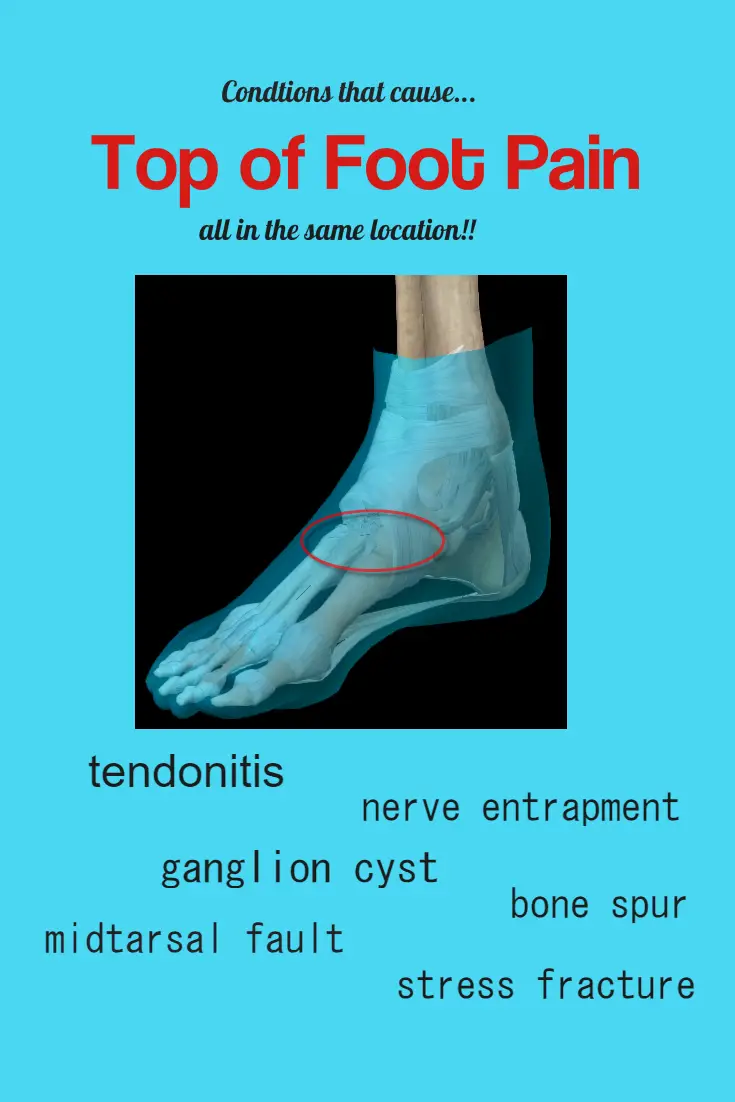
The purpose of this page is to give you information seekers an easier way to diagnose your pain on the top of the foot. I have noticed that many people use top of foot pain as their "search" term. by knowing the location of your pain it becomes easier to determine its source.
Although my homepage has a Foot-Pain-Finder which helps you identify the type of pain you may be suffering from, I thought a page listing specific symptoms on top of the foot would make things simpler.
I have listed the more common problems that we foot specialists see on a regular basis, but this list is not all inclusive. Some of these conditions have separate pages which discuss them, a few of them do not (at least at this point in time).
Hopefully this will help you in your search for answers.
tendonitis Diffuse pain on top of the foot which may also include swelling and even redness. There may or may not be a history of trauma.
ganglion cyst A spongy to firm lump on top of the foot that may or may not be freely moveable. The lump itself may not be painful on pressure, but pressing on it may cause pain beneath it.
midtarsal fault In people whose feet have a tendency to collapse (fallen arches), there ends up being a jamming of the bones on top of your foot that will lead to pain, with or without shoes. Generally, there will be no history of trauma.
nerve entrapment There are small nerves running from the ankle down to the toes that are located right under the skin. These are sensory nerves (which give us feeling on the top of the foot). It is not uncommon for these nerves to become traumatized from the pressure of a shoe (mainly tied too tight) putting pressure on the nerve which is then "jammed" into a bony projection underneath it. This nerve is then entrapped and it becomes inflamed and thus painful or in some cases there will be numbness on part of the top of the foot.
stress fracture Without any history of trauma, a person can develop severe pain on the top of the foot usually in the metatarsal area. It will be a localized pain, possibly with some swelling and perhaps redness.
bone spur A bone spur in the foot is usually a result of arthritic changes in the foot, bone will overgrow and produce abnormal protrusions on top of the foot. Either damage to the specific joint or pressure from your shoe on the overgrowth of bone (bone spur) will cause pain.
superficial phlebitis Many of the veins on the top of the foot are directly underneath the skin. Since the foot is subject to trauma every step you take, at times the superficial veins will become inflamed and develop a superficial phlebitis. This is not as dangerous as a deep vein phlebitis seen in the leg, but medical care is warranted.
REFERENCES
Want more information? CLICK HERE


Recent Articles


-
Vitamin D impact on health
Feb 06, 23 07:17 PM
Researchers are suggesting that the effectiveness of Vitamin D in fighting and preventing disease is predicated on a persons body mass index (BMI). The thinner the person the greater the positive impa… -
Foods to speed up healing
Feb 01, 23 02:41 PM
One of the best ways to help yourself heal faster after surgery is to eat well. Getting the proper nutrition will provide your body with the essentials it needs to promote healing. Here is a suggestio… -
Cancer and Type 2 Diabetes
Jan 25, 23 04:52 PM
An article revealing that older type 2 diabetics have a higher incidence of cancer then non-diabetics. It is suggested that cancer may surpass CVD as the number one cause of death in older diabetics. -
Does glucosamine or MSM reduce arthritis pain?
Jan 22, 23 01:41 PM
A good review of the possible benefits to taking glucosamine, chondroitin or MSM for arthritis. Always beware of the possible side effects of over the counter supplements. -
shin splints
Jan 18, 23 05:12 PM
A great review on the various causes of shin splints, along with treatment options. -
Whats new in skin cancer?
Jan 15, 23 08:32 PM
A presentation of newer skin protection combinations in an effort to better protect the skin from the hazards of sun exposure. -
Causes and risk factors of warts
Jan 14, 23 05:02 PM
A good review of the causes of warts and protective measures you can take to prevent developing them. -
Do chronic wounds need to be dressed daily?
Jan 11, 23 02:18 PM
Because of supply chain shortages as well as staffing shortages particularly during the pandemic, many institutions extended the time between dressing changes for chronic wounds. Is this really the be… -
Food choices that raise your risk of type 2 diabetes
Jan 08, 23 10:07 AM
A good review of how blood sugars can become elevated and the harm that can do. Certain food groups have a tendency to raise your blood sugars and should be avoided. -
Outcome stats from Scarf bunionectomy
Jan 03, 23 03:04 PM
The Journal of Foot and Ankle Surgery recently reported a meta analysis of outcomes in 1583 Scarf bunionectomies that met their inclusion criteria. Adverse events did not seem to be any better or wors…
