paronychia
AUTHOR: Marc Mitnick DPM home --> paronychiaWHAT IS A PARONYCHIA
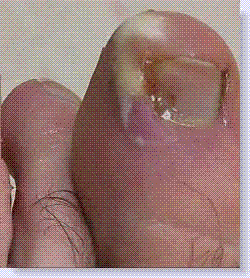
This is an infected ingrown toe nail. It is generally the result of an ingrown nail piercing the surrounding flesh, bacteria the gets into the opening and it becomes infected. Less commonly the cause can be from trauma to the nail such as dropping something on the toe, or what I like to refer to as micro trauma which is repeated pressure against the nail as might be seen in someone who plays soccer or tennis where the toe is constantly being jammed into the end of the athletic shoe.
Another cause of a paronychia is poor cutting technique of the patient in trimming their own nails. People have come to me as a result of using a nail salon where the pedicurist attempted to cut out an ingrown nail, only to see it get infected.
Below is a picture of an infected ingrown toe nail (paronychia)
|
This is a bacterial infection which needs medical attention. Aside from the pain factor if left alone the infection can spread. Generally in a healthy individual you will see a reactive cellulitis which is redness in the immediate surrounding area. However, in a diabetic or person with poor circulation or other debilitating illness, the infection can spread and you may see an ascending cellulitis meaning the redness travels up the foot, possibly up to the leg. In these same individuals the tissue in the infection site may begin to breakdown leading to ulceration or gangrene (depending on how bad the circulation is).
In other instances, in an untreated ingrown toe nail, the bacteria may invade the adjacent bone leading to a bone infection known as osteomyelitis. As you can imagine a bone infection is a very serious problem and may require surgical removal of the infected bone. If you present to your doctor's office with a longstanding paronychia, your doctor may order an x-ray of the ingrown toe nail.
It has been my experience that rarely a paronychia clears up on its own, although it can happen. More likely the portion of ingrown toe nail will have to be removed. Many times this can be done without local anesthesia, but sometimes the toe does have to be put to sleep in order to remove the offending nail. If a patient comes to the office with a first time problem, I generally just remove the ingrown nail with the understanding that the piece of nail removed will grow back. However, if a patient develops a recurring problem I generally recommend an office procedure whereby the offending piece of nail is removed on a permanent basis. It is important to note, that only the ingrown portion of the nail not the whole nail needs to be removed.
Below is a video of a phenol and alcohol technique (P&A), for removing an ingrown toe nail. This is an office procedure done under local anesthesia. After the ingrown nail is removed the growth plate (matrix) is destroyed using repeated applications of phenol, a matrixectomy. The remaining phenol is then neutralized by applying alcohol to the area. (This surgical video was not performed by me.)
TREATMENT FOR INGROWN TOE NAIL
In most cases an antibiotic without nail removal will not work. What I have seen over the years is patients who were put on oral antibiotics by their primary care doctor and while the toe seemed to improve while they were on the medication as soon as they finished they ended up with a worsening of the toe. If the nail is piercing the flesh it is almost always going to re-infect unless it is removed.
care of paronychia before seeing the doctor
Should you develop a paronychia or even just a painful ingrown nail, the best thing you can do initially until you can seek treatment is to soak the foot in a solution of table salt or Epsom salt using one tablespoon per quart of warm (not hot) water for 15-20 minutes. If the solution burns then reduce the amount of salt. After soaking, apply an antibiotic ointment and dressing. Not only will the ointment help the infection but it will soften the surrounding skin making the toe less painful. Do this repeatedly until you can have professional care.
If you are diabetic or have compromised circulation, seeking immediate medical care is mandatory.
Sometimes patients will present with a paronychia that has a bright red growth coming out of the side of ingrown nail. This is known as a granuloma. It is an accumulation of blood cells, bacteria and scar tissue. In itself it is nothing serious other than it tends to bleed a lot if traumatized. When the ingrown nail is removed we generally cauterize the granuloma. One word of caution; if the granuloma keeps coming back (with or without an ingrown nail) it should be removed and biopsied. In very rare instances these innocuous granulomas may actually be a melanoma, which is a very serious skin cancer. It requires immediate medical attention.
PREVENTING INGROWN NAILS
Unfortunately, there are some nails that are just predisposed to growing inward. Examples would include nails that have been subjected to trauma, nails that have fungus underneath them which forces the center of the nail upwards while causing the sides to grow into the flesh. Abnormally shaped medial and lateral nail folds may also predispose nails to grow in and become painful. Lastly, nails that are very thin and hard which makes them very sharp will also tend to cause ingrown nails.
For the rest of you, there are some simple things you can do to prevent normally growing nails from becoming chronic ingrown nails.
1. cut your nails straight across and avoid cutting down the sides of the nails.
2. avoid nail salons as many pedicurists think they are amateur foot doctors and try cutting out ingrown nails usually ending up creating infections.
3. actually cutting your nails with a sharp instrument instead of trying to "pick" the nail and end up leaving rough edges particularly on the side of the nail.
4. wear shoes with a wide toe box and lower heel in order to not force your toes into the end of the shoe.
5. believe it or not, sometimes foot structure can aggravate an ingrown nail. An example would be a bunion deformity, which might aggravate the nail on the inside of the nail. In some cases the bunion may have to be corrected in order to alleviate chronic ingrown nail pain.
6. nail fungus may exacerbate ingrown nail pain. Clearing up the fungus can help relieve the pain from ingrown nails.
REFERENCES
Want more information? CLICK HERE

Recent Articles


-
Vitamin D impact on health
Feb 06, 23 07:17 PM
Researchers are suggesting that the effectiveness of Vitamin D in fighting and preventing disease is predicated on a persons body mass index (BMI). The thinner the person the greater the positive impa… -
Foods to speed up healing
Feb 01, 23 02:41 PM
One of the best ways to help yourself heal faster after surgery is to eat well. Getting the proper nutrition will provide your body with the essentials it needs to promote healing. Here is a suggestio… -
Cancer and Type 2 Diabetes
Jan 25, 23 04:52 PM
An article revealing that older type 2 diabetics have a higher incidence of cancer then non-diabetics. It is suggested that cancer may surpass CVD as the number one cause of death in older diabetics. -
Does glucosamine or MSM reduce arthritis pain?
Jan 22, 23 01:41 PM
A good review of the possible benefits to taking glucosamine, chondroitin or MSM for arthritis. Always beware of the possible side effects of over the counter supplements. -
shin splints
Jan 18, 23 05:12 PM
A great review on the various causes of shin splints, along with treatment options. -
Whats new in skin cancer?
Jan 15, 23 08:32 PM
A presentation of newer skin protection combinations in an effort to better protect the skin from the hazards of sun exposure. -
Causes and risk factors of warts
Jan 14, 23 05:02 PM
A good review of the causes of warts and protective measures you can take to prevent developing them. -
Do chronic wounds need to be dressed daily?
Jan 11, 23 02:18 PM
Because of supply chain shortages as well as staffing shortages particularly during the pandemic, many institutions extended the time between dressing changes for chronic wounds. Is this really the be… -
Food choices that raise your risk of type 2 diabetes
Jan 08, 23 10:07 AM
A good review of how blood sugars can become elevated and the harm that can do. Certain food groups have a tendency to raise your blood sugars and should be avoided. -
Outcome stats from Scarf bunionectomy
Jan 03, 23 03:04 PM
The Journal of Foot and Ankle Surgery recently reported a meta analysis of outcomes in 1583 Scarf bunionectomies that met their inclusion criteria. Adverse events did not seem to be any better or wors…