piezogenic papules
AUTHOR: Marc Mitnick DPMREVIEWED BY: Podiatric Medical Review Board
home --> piezogenic papules
WHAT ARE PIEZOGENIC PAPULES
This is a reasonably common foot complaint that brings patients into the office. They are concerned about the “lumps” that are occurring on either or both heels.
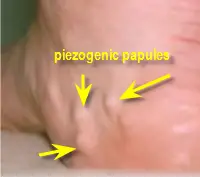
They are a pressure induced herniation of the subcutaneous fat through the fascial lining of the heel. Fascia is a covering over soft tissue, underneath the skin, similar in appearance to saran wrap. What happens is that the fat herniates or protrudes through small tears in the fascial lining resulting in nodules or lumps that are seen in the heel area. Diagnosis is made solely on physical examination; there is no lab work or imaging studies that will diagnose piezogenic papules.
These are benign lesions (non-malignant). The image below is a typical presentation of piezogenic papules.
|
Off weight bearing they can be difficult to see but on weight bearing they become pronounced but rarely painful. Defects in the fascial lining allow the fat to protrude through and press against the skin creating the lumps. These lumps can be seen on the medial (inside), lateral (outside) and posterior aspect of the heel and can occur on either heel or both heels. They have also been diagnosed on the wrist.
The tendency for this condition is more common in young and athletic people. There is no racial or hereditary predisposition. They are seen slightly more in women then men. In the small percent of patients who experience pain from these herniations the patients tend to be obese or those prone to long periods of standing.
HOW DO YOU TREAT PIEZOGENIC PAPULES
The first treatment is reassurance that these “growths” are harmless. However, if there is any concern that these growths are anything but a piezogenic papule then a biopsy should be performed.
Plastic heel cups- In those individuals where there is some degree of pain or discomfort, plastic heel cups can be very helpful. These are plastic egg shell shaped devices that are placed around the heel. What they basically do is push the fat back into the fascial defect.
4% denatured alcohol injections- Many foot specialist may also recommend one or more injections of 4% denatured alcohol. This is particularly effective if there is a burning component to the pain as the injections sclerose or deaden the nerves that end at the level of the papules. This is the same injection that we use for Morton's neuroma.
cortisone injections-Injecting the protrusions may shrink their size and make them less pronounced and thus less painful.
reduce standing-For those who are overweight or have occupations that require them being on their feet for prolonged periods of time.
Surgical excision- On very rare occasions they have to be excised. This is generally limited to instances where there is nerve tissue embedded in the fat that is protruding through the fascial defect.
see related article....Morton's neuroma
REFERENCES
Want more information? CLICK HERE


Recent Articles


-
Vitamin D impact on health
Feb 06, 23 07:17 PM
Researchers are suggesting that the effectiveness of Vitamin D in fighting and preventing disease is predicated on a persons body mass index (BMI). The thinner the person the greater the positive impa… -
Foods to speed up healing
Feb 01, 23 02:41 PM
One of the best ways to help yourself heal faster after surgery is to eat well. Getting the proper nutrition will provide your body with the essentials it needs to promote healing. Here is a suggestio… -
Cancer and Type 2 Diabetes
Jan 25, 23 04:52 PM
An article revealing that older type 2 diabetics have a higher incidence of cancer then non-diabetics. It is suggested that cancer may surpass CVD as the number one cause of death in older diabetics. -
Does glucosamine or MSM reduce arthritis pain?
Jan 22, 23 01:41 PM
A good review of the possible benefits to taking glucosamine, chondroitin or MSM for arthritis. Always beware of the possible side effects of over the counter supplements. -
shin splints
Jan 18, 23 05:12 PM
A great review on the various causes of shin splints, along with treatment options. -
Whats new in skin cancer?
Jan 15, 23 08:32 PM
A presentation of newer skin protection combinations in an effort to better protect the skin from the hazards of sun exposure. -
Causes and risk factors of warts
Jan 14, 23 05:02 PM
A good review of the causes of warts and protective measures you can take to prevent developing them. -
Do chronic wounds need to be dressed daily?
Jan 11, 23 02:18 PM
Because of supply chain shortages as well as staffing shortages particularly during the pandemic, many institutions extended the time between dressing changes for chronic wounds. Is this really the be… -
Food choices that raise your risk of type 2 diabetes
Jan 08, 23 10:07 AM
A good review of how blood sugars can become elevated and the harm that can do. Certain food groups have a tendency to raise your blood sugars and should be avoided. -
Outcome stats from Scarf bunionectomy
Jan 03, 23 03:04 PM
The Journal of Foot and Ankle Surgery recently reported a meta analysis of outcomes in 1583 Scarf bunionectomies that met their inclusion criteria. Adverse events did not seem to be any better or wors…