capsulitis
AUTHOR: Marc Mitnick DPM home --> capsulitisWHAT IS CAPSULITIS
Capsulitis by definition is inflammation of a ligament. Anywhere in the body where two bones come together they form a joint; that is what allows movement within the skeletal system. (Your ankle bending up and down is movement of a joint.)
Surrounding the joint are the capsular ligaments, which act to keep the two bones lined up in approximation so that the joint can function in its optimal range. Ligaments are very tough tissue, almost leather like in texture.
The problem is that you have leather like structures trying to hold bone together (healthy bone has a tensile strength similar to low grade steel). If there is any stress placed on the joint from trauma, or abnormal biomechanical functioning you can be sure the “leather” is going to give out first before the “steel” does. This is what causes capsulitis.
Keep in mind that this problem can occur at any joint in the human body and even occurs in a number of places on the foot, but we are going to discuss the classic “foot capsulitis” as seen in the foot in the area of the metatarsal-phalangeal joint. As it turns out 1st metatarsal phalangeal capsulitis has its own name and is called turf toe.
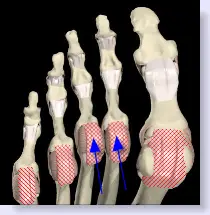
Below is a skeletal model of the bottom of the forefoot. Note the red checkered area; that is the plantar ligament that is part of the capsular ligament which actually surrounds the whole joint. I have highlighted the plantar ligament because that is the part of the capsular ligament that is most affected in this condition.
 |
WHAT CAUSES CAPSULITIS
ACTIVITIES-such as stooping while gardening (similar to the rear foot on the male image below), constantly climbing ladders, doing work low to the ground like electrical or plumbing work. Sports activities such as running, where there is a constant excessive bending of the toes at the level of the metatarsal heads. Walking barefoot, quite often, may also create this problem.
SHOES-wearing very high heel shoes. This causes a constant bending at the level of the metatarsal heads which can allow them to over stretch.
Flimsy shoes like flip-flops or ballerina shoes, all cause excessive bending of the toes at the level of the blue arrows. The constant excessive bending of these toes will eventually cause the ligaments to overstretch, become inflamed, and then begin to hurt.
FOOT ARCHITECTURE-the way your foot is structured, can make some people more susceptible to this condition. Look at the x-ray in the pictures below. You will see the first metatarsal bone is much shorter than the second metatarsal bone. This excessive shortening creates more pressure on the second metatarsal bone at the level of the toes and this may very well end up in a capsulitis.
Keeping with my ongoing theme throughout this site; once you have a foot injury, walking on it just re-injures the injured area and thus increases the time it takes for the area to get better, if at all.
 |
DIAGNOSING CAPSULITIS
Typically a patient will present to the office complaining of pain in the forefoot, probably not relating any specific history of trauma, but the pain is just an ongoing nagging type pain. Many times the patient will have neuroma type symptoms. Click here for more information on Morton's neuroma. If you look at the site of Morton's neuroma and capsulitis you can easily see how they can be misinterpreted.
Sometimes, but not always, an x-ray may be taken to rule out a stress fracture or possible arthritis within the joint.
In most cases, pressing with your thumb at the level where the toe meets the metatarsal head (blue arrows), pain will be felt. Neuroma pain generally occurs between the metatarsal heads, while metatarsalgia will occur directly on pressure on the metatarsal head.
An experienced foot specialist should be able to differentiate between the two conditions. Many practitioners not totally familiar with foot pathology will come up with the wrong diagnosis.
CAPSULITIS OF THE SECOND TOE
severe second toe pain
Of all the toes that can be affected, capsulitis of the second toe, resulting in pain appears to be the most prevalent, and there is a reason for this.
As noted in the x-ray above, for many people, the second metatarsal will bear a greater share of body weight then the other metatarsals.
This is due for one of two reasons. Either the second metatarsal is longer then the first metatarsal as depicted in the x-ray, or, the first metatarsal is hypermobile, meaning it has a tendency to move upwards during the gait cycle, which in turns puts more pressure on the second metatarsal.
Either of these situations may lead to severe second toe pain. The third, fourth and fifth metatarsals are not affected by this phenomenon.
Morton's neuroma may also lead to second toe pain as well.
It is also worth noting that these factors also make the second metatarsal more prone to stress fractures compared to the other metatarsals.
TREATMENT OF FOOT CAPSULITIS
The good news is some of the conservative treatments for neuroma will also help capsulitis, so even if your doctor is not quite accurate with the diagnosis, relief may still be obtained.
CORTISONE INJECTION-should help both conditions. Sometimes upwards of three injections over a course of 3-6 weeks may be necessary to quiet down the pain.
ORAL ANTI-INFLAMMATORY MEDICATION-for short duration only.
SHOE SELECTION-avoiding high heels along with boat shoes, flip flops or any shoe with very flimsy soles should also help as well. Additionally, avoid going barefoot for extended periods of time. The best shoes for capsulitis include those with a stiff and cushioned sole such as those found in most sneakers and casual laced shoes.
REDUCTION IN CERTAIN ACTIVITIES-avoiding activities which seem to exacerbate the problem. If you do not eliminate the activities that are creating the problem, then the chances of this condition clearing up, even with medical intervention, is drastically reduced.
ORTHOTIC WITH METATARSAL PAD-in individuals where the pain improves but does not “go away” many times I will put them in prescription orthotics with a built in metatarsal pad that basically lifts the metatarsal bone so there is not so much stretching of the plantar capsule as the patient walks. The best orthotics for capsulitis must contain a metatarsal pad or metatarsal bar.
IMMOBILIZATION-wearing a surgical shoe or use of a CAM walker, keeps the toes from bending and over the course of a few weeks can result in the resolution of the problem.
PHYSICAL THERAPY-for capsulitis may be attempted but it should be done in conjunction with immobilization of the affected joint(s).
SURGERY-people that have rigid hammertoes are more prone to this condition because the nature of the hammertoe deformity itself stretches the ligament. In these cases if all else fails, surgical correction of the hammertoes can be very rewarding.
Sometimes a variation in the normal foot architecture (as described above) of the metatarsal bones may cause a capsulitis with none of the other precipitating factors present. Usually a prescription orthotic will help these individuals as well. In instances where an orthotic does not help, surgical remodeling of the metatarsal bone may be necessary. The goal of this surgery is to create a better metatarsal alignment between the affected metatarsal bone and the metatarsal bones adjacent to it.
Lastly, a condition known as a "plantar plate tear" is a worsening of this condition. In this instance the ligament has actually torn. This diagnosis can only be made with an MRI or injection of dye into the joint, and then checking for leakage out of the joint. So, in instances where you are undergoing conservative treatment with no real improvement, further testing would be indicated. In many instances this ends up with surgical intervention, although a six week course of immobilization may also be attempted.
Treatment in these instances may require not only repair of the torn ligament, but surgical correction of any bony abnormalities that may have precipitated the condition.
Again, a conservative regimen of immobilization of the joint for a period of 4-6 weeks should be tried first in an effort to allow the ligament to heal on its own. If that fails to solve the problem, then surgery would be the next step.
REFERENCES
Want more information? CLICK HERE
Para traducir esta pagina, ve al boton de traduccion de Google en las esquina superior derecha de la pagina

Recent Articles


Vitamin D impact on health
Feb 06, 23 07:17 PM
Researchers are suggesting that the effectiveness of Vitamin D in fighting and preventing disease is predicated on a persons body mass index (BMI). The thinner the person the greater the positive impa…Foods to speed up healing
Feb 01, 23 02:41 PM
One of the best ways to help yourself heal faster after surgery is to eat well. Getting the proper nutrition will provide your body with the essentials it needs to promote healing. Here is a suggestio…Cancer and Type 2 Diabetes
Jan 25, 23 04:52 PM
An article revealing that older type 2 diabetics have a higher incidence of cancer then non-diabetics. It is suggested that cancer may surpass CVD as the number one cause of death in older diabetics.Does glucosamine or MSM reduce arthritis pain?
Jan 22, 23 01:41 PM
A good review of the possible benefits to taking glucosamine, chondroitin or MSM for arthritis. Always beware of the possible side effects of over the counter supplements.shin splints
Jan 18, 23 05:12 PM
A great review on the various causes of shin splints, along with treatment options.Whats new in skin cancer?
Jan 15, 23 08:32 PM
A presentation of newer skin protection combinations in an effort to better protect the skin from the hazards of sun exposure.Causes and risk factors of warts
Jan 14, 23 05:02 PM
A good review of the causes of warts and protective measures you can take to prevent developing them.Do chronic wounds need to be dressed daily?
Jan 11, 23 02:18 PM
Because of supply chain shortages as well as staffing shortages particularly during the pandemic, many institutions extended the time between dressing changes for chronic wounds. Is this really the be…Food choices that raise your risk of type 2 diabetes
Jan 08, 23 10:07 AM
A good review of how blood sugars can become elevated and the harm that can do. Certain food groups have a tendency to raise your blood sugars and should be avoided.Outcome stats from Scarf bunionectomy
Jan 03, 23 03:04 PM
The Journal of Foot and Ankle Surgery recently reported a meta analysis of outcomes in 1583 Scarf bunionectomies that met their inclusion criteria. Adverse events did not seem to be any better or wors…