blue toe syndrome
home --> blue toe syndrome
WHAT IS BLUE TOE SYNDROME
This is the bluish discoloration of toes that occurs as a result of tissue ischemia (lack of blood flow). The syndrome is caused by the blockage of small vessels that lead into the toes. One or more toes may be affected and can occur on one or both feet.
In severe cases this can also manifest itself as a multi-organ problem where primarily the kidney is also affected.
This condition is seen more in males than females primarily because males suffer from more heart disease. The disease appears to be more prevalent in whites than blacks, even though African-Americans suffer from more heart disease than whites, the thought is that the discoloration is just harder to diagnose in dark skinned individuals.
The age range can be anywhere from the late twenties to people well into their nineties, but the majority of cases occur in the 65-75 age range.
WHAT CAUSES BLUE TOE SYNDROME

the most common cause is the breakage of a small piece of arterial plaque usually from the abdominal aorta-iliac-femoral arterial system (located in the abdomen and groin area, at the level of the top two yellow arrows in the diagram) which then travels down the arterial tree, represented by the red arrows into the small vessels of the foot where it becomes lodged. This is known as an embolism. People with heart disease have a greater propensity for this scenario.
- interventional surgical procedures on the vascular system such as open heart surgery and arterial repair can be a precipitator.
- anticoagulant medication (blood thinners) can cause this problem.
- hypercoagulable blood, blood which is too thick, as seen in polycythemia vera, may also be a cause for a clot.
- trauma to blood vessels
- atrial fibrillation
- scleroderma
- at the local level, the syndrome may occur in diabetic foot infections and those who have undergone foot surgery
SYMPTOMS OF BLUE TOE SYNDROME
Some of the toes will have a blue discoloration in them that will remain whether the foot is in a dependent or elevated position.
Depending on the degree of blockage the toes may then form ulcers or may progress to gangrene.
Livedo reticularis, as seen in the image below, is a mottling of skin color, is a secondary finding in many instances.
The patient may also complain of severe pain in the toes as well as pain elsewhere, if other organs are involved.
Raynauds phenomenon, commonly seen as a blanching in skin color, primarily in the fingers, may also be seen in younger patients without any known history of atherosclerotic disease and who are suffering from this syndrome, as well.
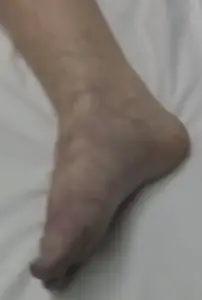
DIAGNOSIS OF BLUE TOE SYNDROME
Blue toe syndrome is easily misdiagnosed because in most cases the larger arteries of the foot are palpable and that directs the doctor away from a diagnosis of occlusive disease.
However, in those individuals with a history of heart disease, palpable lower extremity pulses, livedo reticularis and pain, a diagnosis of blue toe syndrome has to be ruled out.
In younger individuals, Raynaud's disease and vasospastic disorders have to be ruled out.
Vascular testing is usually required to make the diagnosis. A peripheral angiogram is performed with the knowledge that the test itself could actually make the problem worse.
TREATMENT OF BLUE TOE SYNDROME
Treatment is geared towards alleviation of the blockage further up the arterial tree through stenting, bypass surgery, or anticoagulant therapy. Vasodilator drugs have no proven effectiveness in treatment of this condition, since this is not a vasospastic disorder.

Mild forms of the disease which affect just the toes have a good prognosis and usually subside on their own. It should be noted that sometimes the pain in the toes is disproportional to the extent of involvement of the toes and adequate analgesics should be prescribed. In multi-systemic forms where the kidney is also usually affected, the prognosis is more dubious.
In the foot, should the condition not resolve itself there is always the possibility that the condition will worsen to gangrene and subsequent amputation of the affected toes.
REFERENCES
Euoropean Journal of Cardiology
See my discussion on peripheral circulation.
Want more information? CLICK HERE
Para traducir esta pagina, ve al boton de traduccion de Google en las esquina superior derecha de la pagina
AUTHOR: Marc Mitnick DPM


Recent Articles


-
Vitamin D impact on health
Feb 06, 23 07:17 PM
Researchers are suggesting that the effectiveness of Vitamin D in fighting and preventing disease is predicated on a persons body mass index (BMI). The thinner the person the greater the positive impa… -
Foods to speed up healing
Feb 01, 23 02:41 PM
One of the best ways to help yourself heal faster after surgery is to eat well. Getting the proper nutrition will provide your body with the essentials it needs to promote healing. Here is a suggestio… -
Cancer and Type 2 Diabetes
Jan 25, 23 04:52 PM
An article revealing that older type 2 diabetics have a higher incidence of cancer then non-diabetics. It is suggested that cancer may surpass CVD as the number one cause of death in older diabetics. -
Does glucosamine or MSM reduce arthritis pain?
Jan 22, 23 01:41 PM
A good review of the possible benefits to taking glucosamine, chondroitin or MSM for arthritis. Always beware of the possible side effects of over the counter supplements. -
shin splints
Jan 18, 23 05:12 PM
A great review on the various causes of shin splints, along with treatment options. -
Whats new in skin cancer?
Jan 15, 23 08:32 PM
A presentation of newer skin protection combinations in an effort to better protect the skin from the hazards of sun exposure. -
Causes and risk factors of warts
Jan 14, 23 05:02 PM
A good review of the causes of warts and protective measures you can take to prevent developing them. -
Do chronic wounds need to be dressed daily?
Jan 11, 23 02:18 PM
Because of supply chain shortages as well as staffing shortages particularly during the pandemic, many institutions extended the time between dressing changes for chronic wounds. Is this really the be… -
Food choices that raise your risk of type 2 diabetes
Jan 08, 23 10:07 AM
A good review of how blood sugars can become elevated and the harm that can do. Certain food groups have a tendency to raise your blood sugars and should be avoided. -
Outcome stats from Scarf bunionectomy
Jan 03, 23 03:04 PM
The Journal of Foot and Ankle Surgery recently reported a meta analysis of outcomes in 1583 Scarf bunionectomies that met their inclusion criteria. Adverse events did not seem to be any better or wors…