eczema (dermatitis)
AUTHOR: Marc Mitnick DPM
REVIEWED BY: Podiatric Medical Review Board
home --> eczema
WHAT CAUSES ECZEMA
This condition, otherwise known as dermatitis account for a large proportion of skin diseases. The most common occurring on the feet is contact dermatitis, meaning inflammation of the skin as a result of contact with an external factor, usually something within the shoe or perhaps a reaction to nylon stockings.
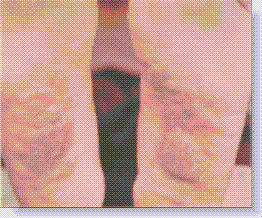
Note in the picture below the contact dermatitis as a result of sensitivity to rubber sole inserts.
|
SYMPTOMS OF ECZEMA
The resulting inflammation itself can be debilitating and is characterized by:
- redness
- swelling
- formation of small blisters
- oozing
- scaling
- itching
chronic symptoms
- scaling
- skin thickening
- fissuring
- lichenification (leathery appearance of skin)
acute symptoms
As bad as all that looks and feels, the bigger problem is the possibility of developing a secondary bacterial infection with a spreading cellulitis. This is particularly dangerous in the debilitated patient or the diabetic or the patient with poor circulation.
TYPES OF ECZEMA
Allergic eczema This dermatitis, by one estimate affects upwards of 4% of the population. It is more prevalent among people who have asthma or hay fever. In these individuals the condition usually starts in infancy and continues into adulthood. This condition is also known as atopic dermatitis and there is a strong familial tendency.
Contact dermatitis This is the most common type seen on the foot. Although in most cases it occurs from direct contact with an irritant, factors such as stress, profuse sweating, a dry environment, and an exposure to hot and cold environments can set it off.
Winter itch is a type of dermatitis that generally occurs on the lower legs. It is the result of diminished moisture in the air which then dries out the skin. It creates a great amount of itching, but because the skin on the lower legs can be thin to begin with, there is a high incidence of 'tearing' the skin by scratching and thus a tendency to infection, even possibly a very slow healing wound. The problem with using cortisone cream on this type of dermatitis is that cortisone will only further thin the skin.
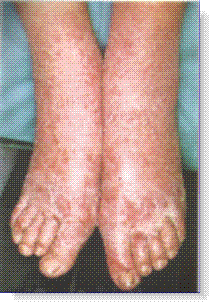
Neurodermatitis This dermatitis usually has emotional origins. This can be particularly bad because the patient will constantly scratch so bad that the eczema will break open and become infected. Note the debilitating case of neurodermatitis below.
|
Other factors that will set off eczema in general include changes in estrogen levels in women, food reactions such as from dairy products, eggs, soy, wheat or peanuts.
It is helpful to know when the outbreaks occurred. Did it happen after playing with the neighbor’s dog, or after spending the afternoon in the park being exposed to ragweed and other grasses? Did you just wear a new pair of shoes or socks?
Even knowing the factors that can set it off, it may be difficult to prevent eczema flare-ups. For no apparent reason the area may start to itch and your normal reaction is to scratch. The problem is that the scratching further inflames the skin and many times will make the rash worse or may spread it beyond its original borders.
REMEDIES FOR ECZEMA
Cortisone creams The simple solution is to try over the counter hydrocortisone creams or prescription grade cortisone creams if the over the counter brands do not work. Just be aware of the fact that chronic use of topical cortisone creams has a tendency to thin out the skin. They can be supplemented with oral antihistamine, but only for short periods of time, to reduce the itch and inflammation. Should the skin become mildly infected adding a topical antibacterial cream like Neosporin or bacitracin can be helpful.
Vitamin A and E lotion As a first of line of defense for preventative measures, applying lotions containing vitamin A and E can soothe and calm the skin making a flare-up less likely.
Lidocaine gels For those whose main complaint is constant itching, using a lotion which is cortisone free but instead contains topical lidocaine may be a better alternative as the lidocaine will take away the itching without thinning out the skin. Elderly patients and those with "thin" skin need to be particularly aware of this.
Should the area become grossly infected, oral antibiotics may be necessary. It also should go without saying that removing the external irritant in the case of contact dermatitis is also mandatory.
Bathing frequently is helpful as soap and water help dry out any "weeping" wounds and contrary to what you may have read, actually moisturizes the skin. When you bathe, use lukewarm water and a mild non-irritating soap.
Immediately after bathing apply liberal amounts of moisturizer to the affected areas. I always tell my patients, that is is not so much what you apply to hydrate your skin (as there are dozens of products on the market), but rather how often you apply the lotion. Three times a day during flare ups is not excessive.
Add one of these to your bath: Some experts recommend adding one of the following to your bath. One half to one cup of baking soda or, 1 to 2 cups of Aveeno (colloidal oatmeal sold in stores) or 1 to 2 cups of finely ground oatmeal bought in the grocery store and then run through your coffee grinder.
Shea butter Some people have very sensitive skin and unfortunately most creams and emollients are made from petroleum by products and have many synthetic ingredients added to them to change the smell or consistency of the cream. For those of you in that category, one option is to try all natural shea butter. This compound has been around for years and is very effective.
Fish oil or fish oil capsules can also be very helpful. The inflammation associated with eczema occurs because your body produces unusually high levels of compounds called prostaglandins. Fish oil is known to reduce this inflammation.
Primrose oil British researchers found that evening primrose oil also provides significant relief from eczema as it is rich in omega-6 fatty acids which are chemically similar to the omega-3 fatty acids found in fish oil.
Because of the unique nature of feet constantly being enclosed in shoes, or if barefoot, being exposed to irritants on the ground, proper cleansing and avoidance of the materials or chemicals that have set off the eczema are mandatory.
Recurrence rates can be very high in the feet.
REFERENCES
American Academy of Dermatology
Want more information? CLICK HERE


Recent Articles


-
Vitamin D impact on health
Feb 06, 23 07:17 PM
Researchers are suggesting that the effectiveness of Vitamin D in fighting and preventing disease is predicated on a persons body mass index (BMI). The thinner the person the greater the positive impa… -
Foods to speed up healing
Feb 01, 23 02:41 PM
One of the best ways to help yourself heal faster after surgery is to eat well. Getting the proper nutrition will provide your body with the essentials it needs to promote healing. Here is a suggestio… -
Cancer and Type 2 Diabetes
Jan 25, 23 04:52 PM
An article revealing that older type 2 diabetics have a higher incidence of cancer then non-diabetics. It is suggested that cancer may surpass CVD as the number one cause of death in older diabetics. -
Does glucosamine or MSM reduce arthritis pain?
Jan 22, 23 01:41 PM
A good review of the possible benefits to taking glucosamine, chondroitin or MSM for arthritis. Always beware of the possible side effects of over the counter supplements. -
shin splints
Jan 18, 23 05:12 PM
A great review on the various causes of shin splints, along with treatment options. -
Whats new in skin cancer?
Jan 15, 23 08:32 PM
A presentation of newer skin protection combinations in an effort to better protect the skin from the hazards of sun exposure. -
Causes and risk factors of warts
Jan 14, 23 05:02 PM
A good review of the causes of warts and protective measures you can take to prevent developing them. -
Do chronic wounds need to be dressed daily?
Jan 11, 23 02:18 PM
Because of supply chain shortages as well as staffing shortages particularly during the pandemic, many institutions extended the time between dressing changes for chronic wounds. Is this really the be… -
Food choices that raise your risk of type 2 diabetes
Jan 08, 23 10:07 AM
A good review of how blood sugars can become elevated and the harm that can do. Certain food groups have a tendency to raise your blood sugars and should be avoided. -
Outcome stats from Scarf bunionectomy
Jan 03, 23 03:04 PM
The Journal of Foot and Ankle Surgery recently reported a meta analysis of outcomes in 1583 Scarf bunionectomies that met their inclusion criteria. Adverse events did not seem to be any better or wors…
